
Emil Kirkegaard v Oliver Smith
Settlement in Kirkegaard v Smith (QB-2018-000390). Although civil litigation ends, Emil Kirkegaard has been reported for perjury, to the Sheridan Police Department, Wyoming.

One of the UK’s longest defamation lawsuits1 Kirkegaard v Smith (QB-2018-000390) has ended including multiple appeals (CA-2023-002246, CA-2024-002547, KA-2025-000049) and my claim2 of harassment Smith v Kirkegaard (KB-2024-000772). Kirkegaard v Smith3 lasted from December 2018 to July 2025, in which I was Defendant. On 19 June 2025, I reached a settlement with Emil Kirkegaard to effectively end all litigation between us. Although the terms of the settlement agreement are confidential, a Tomlin order was sealed on 1 July 2025 (which is public); it mentions that the proceedings were “stayed” and we “agreed to settle”. Kirkegaard breached the terms of this settlement, resulting in me sending a pre-action protocol letter but provided remedy on 30 September 2025.
Despite the breach, I decided not to enforce the terms of the Tomlin order and unstay the proceedings since this would prolong litigation for more years and Kirkegaard has complied with the demands in my letter before claim so this ended the matter (my last correspondence with his barrister was on 7 October 2025). The purpose of this post, is to fully document what Kirkegaard put me through for over six years; the tl;dr version: Kirkegaard filed a frivolous libel lawsuit, lost the preliminary judgment, discontinued his unmeritorious claim, but refused to pay my awarded costs. I initiated enforcement action but found he changed his name to William Engman; moved country and closed his bank account after I filed a third-party debt order to prevent me seizing his assets.
A warrant for his arrest was issued in a bailiff’s court (Fogedretten) in Denmark. It was in effect for several months (since he breached summonses and failed to attend court). His lengthy evasion was likened by a judge at the bailiff’s court to the movie Catch Me If You Can (2002). During proceedings against Kirkegaard in the Court of Appeal, Lord Justice Dingemans summarised his evasion, or noncompliance: “Kirkegaard has made extensive efforts to avoid service” and “taken numerous steps to avoid complying with court orders”.4 He managed to evade police in Denmark (and bailiffs in Germany), but I applied for a suspended committal order against him in England; since he refused to attend the County Court at Central London for debt questioning on 23 January 2025.5

Ultimately, for his non-attendance there would have been an imposed prison sentence (for contempt of court). Realising severity of his situation, Kirkegaard stopped evading me and began to comply with court orders; he resolved the judgment debt by reaching a settlement, which vacated the hearing on my application for a suspended committal order. While the settlement remains private, and I will not breach this confidentiality, I think anyone can take an ‘educated guess’—Kirkegaard paid me a five-digit sum; the judgment debt he owed (over £50,000) was already part of the public record and it was discussed at length in a judgment.6 In 2024, the Danish gazette Statstidende published a summons stating that Kirkegaard owed me the amount DKK 439,967.17 = £51,198.28.
Note: photos below are blurred for privacy and to prevent any copyright infringement reports. Fair use is claimed for screenshots and non-photographic images. If URLs are broken (or offline) check the Internet Archive (here), since I will not be replacing links.
OpenPsych and Doxxing my ISP
I first heard of Emil Kirkegaard’s name in April 2015 when someone told me he had founded with Davide Piffer the previous year open-access journals: Open Differential Psychology, Open Behavioral Genetics, Open Quantitative Sociology and Political Science.7 At the time, I was writing a manuscript on the psychology of UFO reports8 and was looking for a peer-review journal to publish my paper in. I joined OpenPsych’s forum (user: Krom) but quickly realised that OpenPsych was not what it purported to be and its journal’s review process is flawed.9 OpenPsych does not rigorously peer review its papers, contrary to what Kirkegaard claims but he ignored my criticisms and banned my account on 25 February 2016.10 He doxxed my IP, ISP, email, and geo-location.11
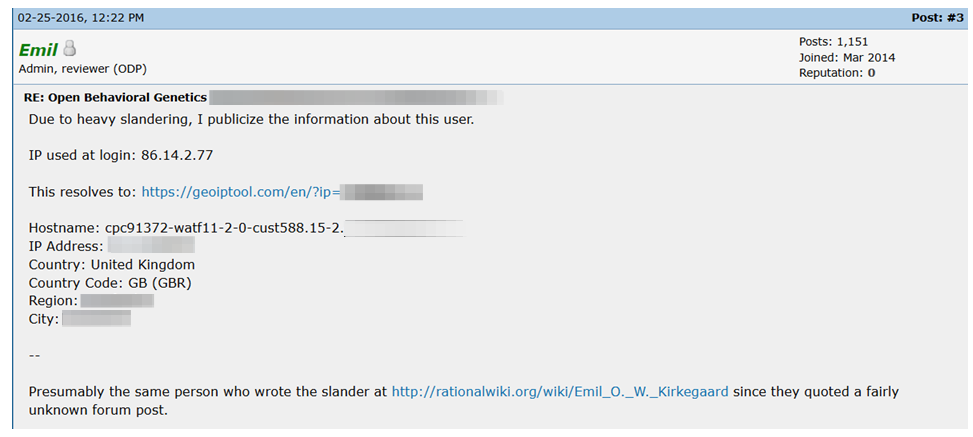
Within two months of doxxed, someone emailed a bogus report to my internet service provider; I received a letter from my ISP stating they had “investigated a report of my internet activities” but were not taking any action because “no crime was committed”. I have little doubt this false report (similar to swatting) was by Kirkegaard. I took legal advice at the time and was told by a solicitor that Kirkegaard had breached my privacy since he posted and misused my private information. This is an actionable civil tort; a claim for damages would also be non-trivial since I had to change ISP to prevent more false reports. As a smokescreen to my potential lawsuit, Kirkegaard legally threatened me, played the victim and accused me of “slandering” him without a shred of evidence.
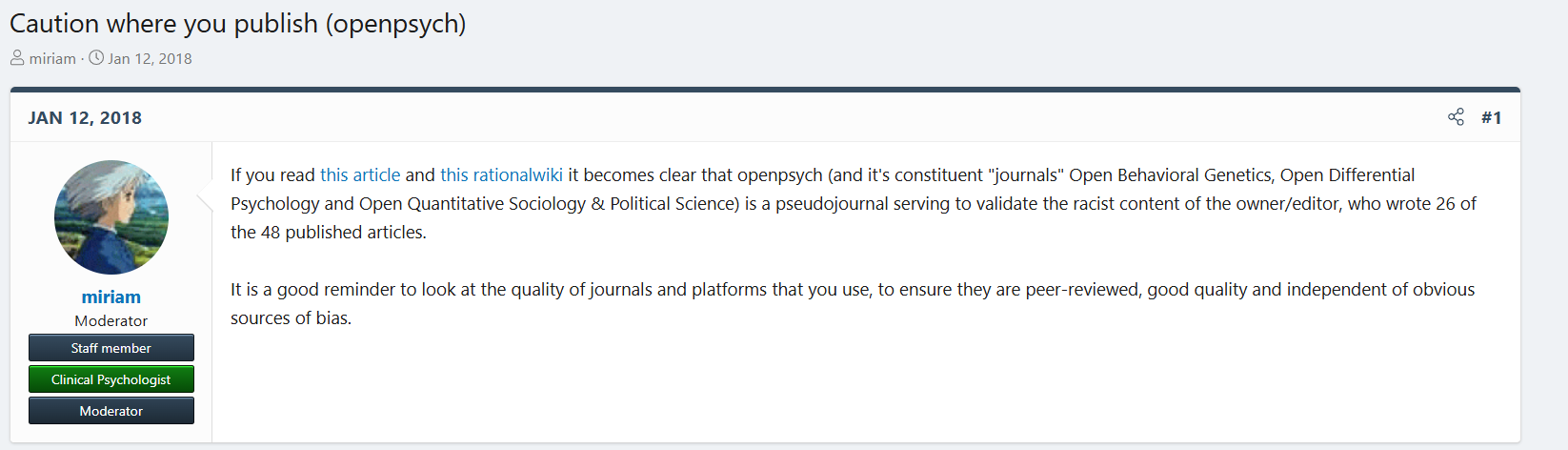
It did not surprise me to learn that other forum posters, before me, complained about “bad experiences at OpenPsych” and some posters even withdrew their manuscripts. I created an article about OpenPsych on RationalWiki to warn people against publishing there largely because of Kirkegaard’s behaviour.12 I am pleased to say this had a lot of success, owing to search engine optimization of the article. For example, a moderator on ClinPsy forum, created a thread cautioning about OpenPsych and the journals have never been indexed in bibliometric databases because they are blacklisted. Amusingly, Davide Piffer (who set up OpenPsych with Kirkegaard) promotes the psychic fraud Uri Geller and delusionally himself believes he has a type of “extra-sensory perception”.13
In August 2017, Kirkegaard showed up at RationalWiki (user: EmilOWK) to complain about my criticisms of his OpenPsych journals but was blocked for doxxing me (again). His account was banned on 19 October 2017 and his unblock request was denied. Not long afterwards, he began legally threatening the RationalMedia Foundation who own and operate RationalWiki. This online wiki is predominantly written from a scientific scepticism point of view and criticises so-called pseudojournals like OpenPsych. To my knowledge, Kirkegaard’s legal threats at this time against the RMF never amounted to anything. He later apparently tried to sue me for edits on the wiki but since he did not have proof I wrote them and confused me with another editor,14 nothing materialised.
The OkCupid Scandal
In May 2016, OpenPsych was embroiled in a scandal that involved doxxing, specifically Kirkegaard had published the data of 70,000 OkCupid users (without their permission) in the journal Open Differential Psychology. Kirkegaard claimed that he was publishing “already public information” but this is questionable. Data he scraped from OkCupid profiles was only accessible if logged in to an account; ethics scholar Michael Zimmer therefore pointed out: “Since OkCupid users [accounts] have the option to restrict the visibility of their profiles to logged-in users only, it is likely the researchers collected and subsequently released the profiles that were intended to not be publicly viewable.” Kirkegaard was subsequently investigated—by the Danish Data Protection Authority.
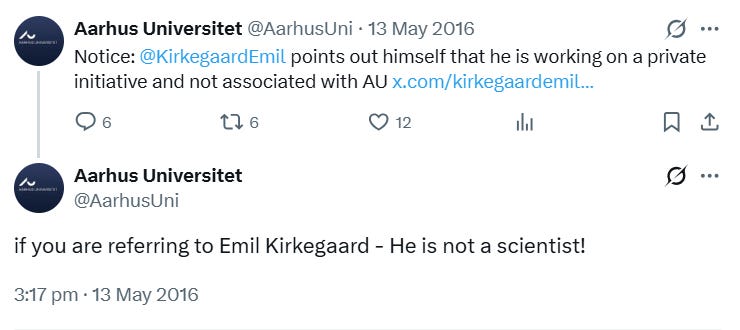
The doxxing incident brought the university he was studying a Master’s degree at the time (Aaarhus University) into disrepute, but they did not expel him. Nevertheless, he dropped out a few months after the controversy.15 He faced a copyright infringement claim since he uploaded OkCupid’s data (without permission) on to the Open Science Framework. His alma mater has published various statements on their official Twitter account clarifying OpenPsych has nothing to do with the university, the upload to OSF was Kirkegaard’s “own initiative” and embarrassingly for him he was “not a scientist”. They further criticised Kirkegaard for exaggerating his curriculum vitae in May 2016; Kirkegaard said his employment was “mostly a scientist” when he was unemployed.16
Despite only holding a bachelor’s degree, Kirkegaard once described himself on social media (Twitter) as: “Polymath, philosopher, politician, logician, linguist, psychologist, programmer”. There is no evidence he is any of these things perhaps with exception of being a linguist (since this was the basis of his undergraduate thesis). To call himself a psychologist with not a psychology degree (nor any formal training) is dubious at best, not to mention it is fraudulent in some jurisdictions.17 Kirkegaard has bragged about being a “polymath” (like Leonardo Davinci), “polymath scientist”, a “universal genius” and apparently claims to have an IQ in the top 2% of the general population (i.e., 98th percentile).18 He has also described himself a “[data] scientist” and “social geneticist”.
At this time, one of Kirkegaard’s critics was Os Keyes, a PhD student at the University of Washington. Keyes wrote an informative blog post on the OkCupid scandal as well and was quoted in another article as saying: “This is without a doubt one of the most grossly unprofessional, unethical and reprehensible data releases I have ever seen”.19 Kirkegaard was thus garnering a bad reputation and in May 2017, the Peace Research Institute Oslo accused him of publishing “fake science”. Keyes co-authored a letter to Aarhus University complaining about Kirkegaard and the university commented that: “We are sure that EK has not learned his methods and ethical standards of research at our university, and he is clearly not representative of the about 38,000 students at AU.”
Emil Kirkegaard and Child Porn
Seeming as Kirkegaard doxxed my ISP and was embroiled in scandals,20 I started to look into his digital footprint. I disturbingly discovered—Kirkegaard once admitted viewing child pornography and wrote comments on the internet, sympathising with legalising the possession of child pornography. In 2013, on a Danish internet forum, Kirkegaard under his real name discussed and linked to a list of illegal websites on a “Danish child porn filter” on Wikileaks (these were websites the Danish government blocked access to). He admitted to viewing these child porn sites (with a Tor browser to hide his Danish IP-address) since he had knowledge the websites “are still up and actually contain child porn” so must have gone through the censored list of websites.
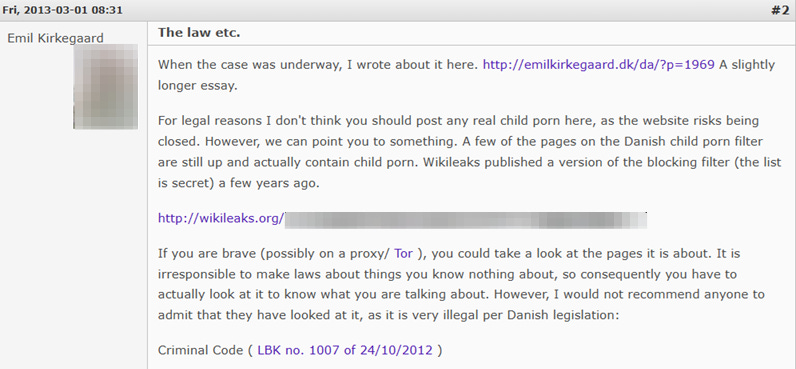
The Danish Criminal Code, notes that anyone who “through the internet […] becomes acquainted with indecent photographs or films, other indecent visual representations or the like of persons under the age of 18” shall be punished by “imprisonment for up to 1 year” or fined.21 Viewing child porn is itself a criminal offence while distributing it has a more severe penalty (by “imprisonment for up to 6 years”). Kirkegaard realised he was breaking the law which explains why he told other forum members if they view child pornography, to use a VPN or a Tor browser to mask their IP-address. At the top of Kirkegaard’s forum post he linked to his own blog post.22 A search revealed that on his website he wrote this post in 2010 (supporting legalisation of animated child porn).
Kirkegaard translated his post into English and reposted it (plus made a downloadable document titled “On the Prohibition of Animated Child Pornography”); the legality of animated (opposed to real) child pornography heavily differs by jurisdiction. It is legal in Denmark, but Kirkegaard’s post was supporting its legalisation in Nordic countries where it is illegal or censored namely Norway and Sweden. Kirkegaard also supported legalising possession of real child pornography. In comments on Rick Falkvinge’s blog in 2012, he wrote reasons he thought it “is a good idea to legalize child porn”. He also has defended Falkvinge (a Swedish activist for legalising child porn) describing him as “brave” and said talking about legalising child porn is “a discussion necessary to have”.
Kirkegaard wrote a separate post about child pornography in 2012 (screenshot). In this post (“The Ban on Child Porn Possession”), when discussing paedophilia he suggested “a compromise is having sex with a sleeping child without them knowing it (so, using sleeping medicine). If they dont [sic] notice it is difficult to see how they cud [sic]23 be harmed, even if it is rape.” Based on this deeply unpleasant blog post; and his support for legalising child porn, Kirkegaard has often been accused of defending paedophilia and described as a “paedophilia apologist”. For example, PZ Myers stated Kirkegaard “justifies child rape”, similarly Stewart Lee in an opinion piece for The Guardian wrote of the “paedophilia apologist […] Emil”. Kirkegaard acknowledged “pedo accusations”.
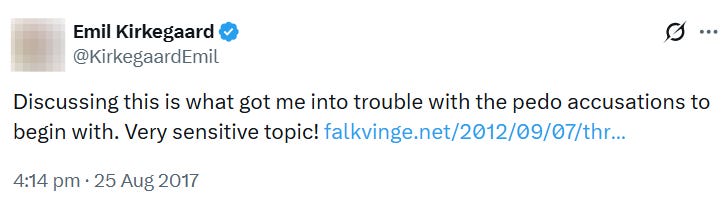
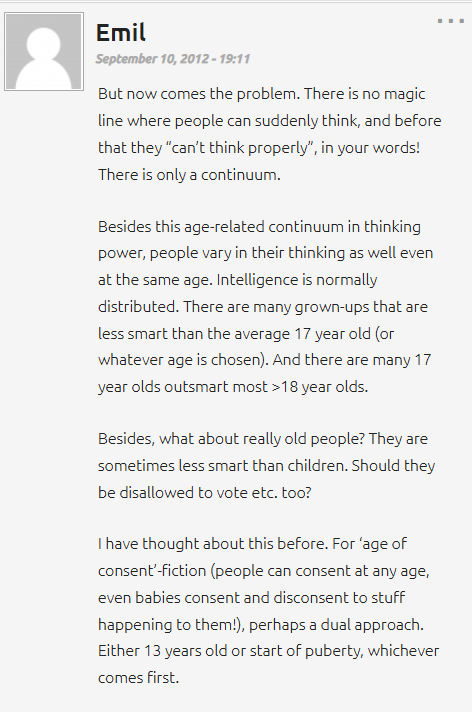
Considering the aforementioned disturbing posts it did not surprise me to learn that Kirkegaard has argued to abolish the age of consent or lower it to 13 (in line with his defence of paedophilia). On the same Danish site he posted a link to a “Danish child porn filter”, he criticised age of consent laws in US states, as being too high (at 16 to 18) and wrote: “It is a stupid idea to have strict age of consent/sexual-underage laws.” In fact, he suggested to fully abolish age of consent laws arguing if sex is consensual between any “persons”, the “state should not interfere” to impose age of consent law. On Falkvinge’s blog, Kirkegaard supported lowering age of consent to 13, or the start of puberty (which begins on average 11) and even described age of consent a “fiction”.
It might be asked if I knew Kirkegaard admitted to viewing child porn, why no police action was taken against him. The answer is by the time I dug up his post, the statute of limitations had passed. I did report him to Danish police twice, but they closed my complaints considering the crime fell well outside of the statute of limitations for the child pornography offence.24 Kirkegaard committed the offence in 2013, but I did not find the post until late 2016 (for crimes with up to a 1 year prison sentence the statute of limitations is only two years to report). It should be noted, the time Kirkegaard was accessing child pornography, he was studying at Aarhus University (bachelor’s degree in linguistics). He could have accessed university computers to access the illegal sites.
OpenPsych, Aporia, Rind et al.
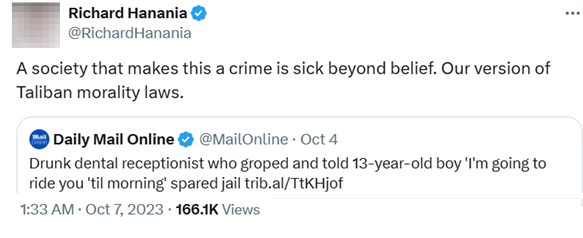
Kirkegaard’s admission to viewing child pornography and his unpleasant writings, led me, over the years, to look at who he associates with and whom defends him. Some of these unsavoury characters publish papers at OpenPsych and have co-authored papers with Kirkegaard, as well as are associated with Kirkegaard’s Aporia Magazine.25 These include: Sebastian Jensen (pseudonym), Joseph Bronski (pseudonym), Richard Hanania and J. Michael Bailey. Jensen made a disturbing tweet about “filling” (with semen) a 15-year old girl. Bronski has been accused of child marriage and paedophilia to the extent his Twitter account was suspended for seemingly confessing that he married someone underage and he was even investigated by the police, yet Kirkegaard has defended him.
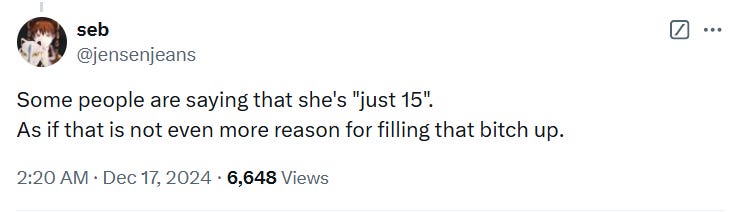
Kirkegaard has never once criticised Sebastian Jensen, for his horrible tweet, in fact, he remains a mutual follower (of his account); and has continued to co-author papers with Jensen at OpenPsych. Kirkegaard himself creepily defends impregnating 15-year olds. In 2023, he wrote a blog post stating that “men’s targeting must be primarily of fecund females” which in his disturbed mind is as young as “age 15”. One year prior, Kirkegaard was accused of “sexualising minors” on social media (for describing a ~16 year old school girl a “fresh fish”). Turning to Hanania, who has appeared on Aporia’s podcast and is occasionally retweeted by Kirkegaard—he has sickeningly defended a 27-year old woman who sexually assaulted a 13-year old boy (by stroking his genitals).
More concerning about Aporia is its association with J. Michael Bailey who has made several controversial tweets on paedophilia. Bailey has bizarrely claimed “everyone is attracted to minors”, denies Jeffrey Epstein was a paedophile (even though he pleaded guilty to soliciting a minor for prostitution and was further indicted on charges of sex trafficking minors as young as 14) and has even defended Epstein by stating “Epstein’s evil has been hugely exaggerated.” With tweets such as these, it is unsurprising Bailey himself has been accused of defending paedophiles or downplaying the harm of child sexual abuse. For example, Bailey has stated that he believes child sexual abuse (CSA) has “been seriously overestimated”. He also thinks penalties against it are “too harsh”.
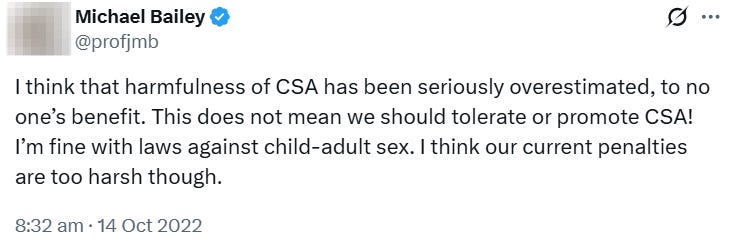
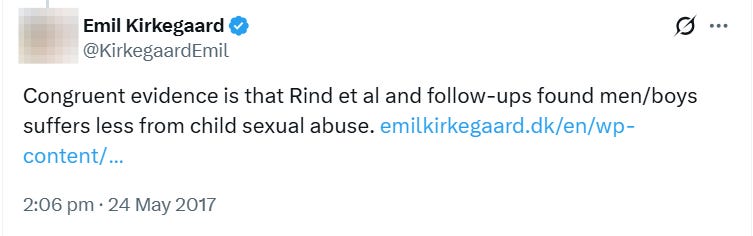
Bailey is a supporter of the infamous meta-analysis (on CSA) by Rind et al. (1998). This controversial paper has been widely criticised for downplaying psychological harm of child sexual abuse and it used a “flawed methodology” (Whittenburg et al. 2001). In the past, Kirkegaard has defended Rind et al., for example, in 2017, he questionably argued there is “congruent evidence […] boys suffer less from child sexual abuse” than girls. In other tweets, he continued to downplay the psychological harm of CSA, believing that it does not have long-term psychological effects. DeWereldMorgen therefore published an article calling Kirkegaard a “pedofilie apologeet” (“pedophile apologist”) compiling his online posts supportive of Rind et al., and downplaying harm of child sexual abuse.
Rind et al., has been supported by individuals and organisations that openly advocate for the abolishing age of consent or decriminalising child sex abuse (Dallam, 2001). In 2020, I came across a self-admitted paedophile named Nathan Larson who said he was writing a manuscript to submit to OpenPsych to “expand on” Rind et al. Larson earlier posted on Reddit he read Kirkegaard’s tweets supportive of Rind et al. I got his Reddit user banned, after reporting it for a patently offensive name (“iluvhvngsexwchildren”). In 2020, Larson was arrested at Denver International Airport for kidnapping a 12-year-old girl, meeting a child for the intention of sex and soliciting child pornography from a minor. Larson died while in custody and it remains unclear if he submitted his paper.
Letter Before Claim
At the start of August 2018, Kirkegaard sent me by post a letter before claim (as a pre-action protocol) for libel, threatening he would sue me in the High Court of Justice in London for six internet posts, dated between January and February 2018 (three on The Unz Review,26 two tweets and one blog post) unless I paid him £40,000, apologised and never repeated the statements. These posts he legally threatened me over called him a “paedophile”. Kirkegaard completely ignored the true context of my posts and wrongly claimed I meant he is a “sexual abuser of children”. There are different meanings27 of the word “paedophile” and I never actually accused him of CSA, furthermore, my four posts were my opinions, not statements of fact which Kirkegaard erroneously claimed.
Kirkegaard has no police or criminal record for child sexual abuse, so by him claiming I accused him of CSA, he was trying to trap me since I would have no legal defence to his claim of libel. However, my six posts did not meant he is a child sex abuser, but an apologist for paedophilia based on hyperlinked sources I provided, in five of the posts (one post was a freestanding tweet); these sources quoted or paraphrased Kirkegaard’s blog posts and comments where he explicitly supported legalising child porn and had suggested to paedophiles to drug and rape sleeping children. In my view, he defended paedophilia but I did not claim he commits or is likely to engage in child sexual abuse himself. In some of the same posts, I used the term “paedophilia apologist”, to clarify.
To sum up, while I did write Kirkegaard is a defender of paedophilia (this remains my opinion) I never accused him of CSA (for which there is no evidence) although the fact he has admitted to accessing child pornography on illegal websites suggests he might be sexually attracted to children (in his defence, Kirkegaard has claimed he did this to understand child pornography laws28), but I have never asserted this. Anyway, since I realised that Kirkegaard was distorting all of my posts, I rejected his gagging attempt, did not apologise to him, nor paid him a penny and put his letter in my trash bin; the vexatious letter was written by Samuels Solicitors so Kirkegaard had hired a solicitor to send a formal legal threat and he himself legally threatened me at The Unz Review.29
Damage Control
I was puzzled why a solicitor firm would take on the libel case, if they had looked into Kirkegaard’s digital footprint since his online posts are plainly interpretable as having defended paedophilia. It was clear from the outset, that I had a strong legal defence of honest opinion (fair comment),30 however, Kirkegaard admitted his lawyer told him to “depublish” these posts. He removed his controversial posts on child pornography the same month his letter before claim, was posted to me. Kirkegaard’s deceptive strategy was therefore to bury the sources (I based my opinions on), and to misconstrue my six posts. My statements were not my bare opinions but opinions based on available facts. Kirkegaard’s ‘deletion-spree’ was apparently to damage control—and I saw through it.
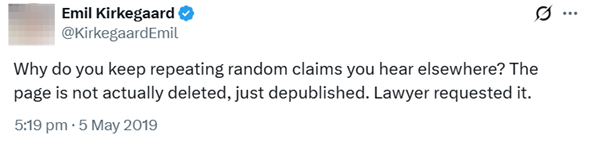
Kirkegaard was able to hide his blog posts but not comments he wrote on Falkvinge’s blog; this left him over the years, with making up excuses. In regard to his comments that supported legalising child pornography he now tried to justify them by claiming he opposes “internet censorship” from “big tech” or capitalists and that he supported decriminalising possession of child pornography on the grounds of liberty. In regards to his support for reducing age of consent, he suddenly said he changed his mind and now opposes lowering the age of consent, claiming: “I don’t advocate any changes to age of consent laws” (contradicting his earlier comments). People can and do change their minds on things but I found the timing to be suspicious and doubt his sincerity.
When questioned about his comment in which he supported lowering age of consent to 13 (or the “start of puberty”), Kirkegaard remarked: “We impose semi-arbitrary age cutoffs for various behaviors, driving a car, owning a gun, having sex, buying alcohol. In a 10 year old comment,31 I pointed out that age of consent varies quite a bit across countries, but a natural point could be age of puberty. However, I’m fine with keeping the Danish age of consent to 15”—this comment is an insight into Emil Kirkegaard’s disturbing mind in which he thinks it is ‘natural’ to have sex with pubescent children. He is wrong about this, of course. It is not a “natural point”, to make age of consent at a pubescent age, but postpubescent age (an age when sexual maturation has finished).
There is more evidence of damage control. Prior to removing his blog posts, he added a note on one of his posts (in which he defended child rape by suggesting paedophiles drug and rape sleeping children) stating: “The blogpost is a thought experiment” and elsewhere claimed it was a “crude Peter Singer like [ethics] post”. Needless to say, this has convinced few people; as somebody pointed out: “Except that if you read the post, it’s very clear that it’s nothing like that.” The problem with taking Kirkegaard’s claim serious his post was a thought experiment is he wrote a separate post unambiguously defending unconscious rape,32 furthermore, Kirkegaard is on record as openly stating he wants to “fight against sexual morality”, and wrote a blog post defending incest.33
In 2012, Kirkegaard positively reviewed a book by paedophilia apologist Chris Brand who was sacked from his job for having defended adults having sex with 12-year olds. Kirkegaard himself, wrote posts downplaying the harm of child sex abuse (see above). However, Kirkegaard now claims he always supported “chemical castration” of child sexual abusers (despite this is not supported by credible evidence). While it is true he once wrote on his website: “the best solution to one who is exclusively aroused by very young children: castration” (my emphasis added) by this he meant infants and toddlers (as the words “very young” do suggest). Why arbitrarily castrate paedophiles who rape children under three, but not over three? Why not castrate every child sexual abuser?
Vexatious Litigant
Aside from legally threatening me (and filing a frivolous libel claim), Kirkegaard has sent formal and informal legal threats to many other individuals who accused him of being a paedophilia apologist. I know this, because he legally threatened my mutual followers on Twitter including a woman who even deleted her account since she was intimidated by his legal threat. Kirkegaard arguably fits the definition of a vexatious litigant—he filed a defamation lawsuit against me purely to harass and silence me as an adversary (critic) not because my posts were untrue or his reputation was harmed. His libel claim and legal threats are completely meritless and anyone labelling him a “paedophilia apologist” would like me have a honest opinion (fair comment) defence.
Kirkegaard has had some success in censoring webpages that factually document his internet posts on child pornography or that merely quote his comments; for example, the aforementioned article by DeWereldMorgen that described Kirkegaard a “pedofilie apologeet” (“pedophile apologist”) was removed despite it accurately quoted his posts downplaying the harm of CSA. Kirkegaard suppressed this information in an attempt to get his posts on paedophilia and child pornography memory-holed. He is known to deindex articles from Google (and other search-engines) which mention his comments on child pornography by sending ‘right to be forgotten’ requests. Kirkegaard currently lives in Germany; he can still deindex webpages under EU privacy law (Art. 17 GDPR).
Claim Form and Particulars
Unfortunately, in the UK there is very little one can do to prevent or quickly throw out a frivolous libel lawsuit. There are options under CPR 3.4(2) to strike out a “statement of case”,34 as an “abuse of the court’s process” or “the claimant has failed to show that it is more likely than not the claim would succeed” (this requires an application and a hearing since the High Court of Justice will rarely strike out a statement of case on its own initiative). Kirkegaard filed his defamation claim against me on 7 December 2018. It was his first claim, so I could not apply for a limited civil restraint order (PD 3C 2.1) which requires at least two claims “totally without merit”.35 I hired a solicitor,36 who sent a letter to Kirkegaard, which noted the libel claim was “entirely devoid of merit”.
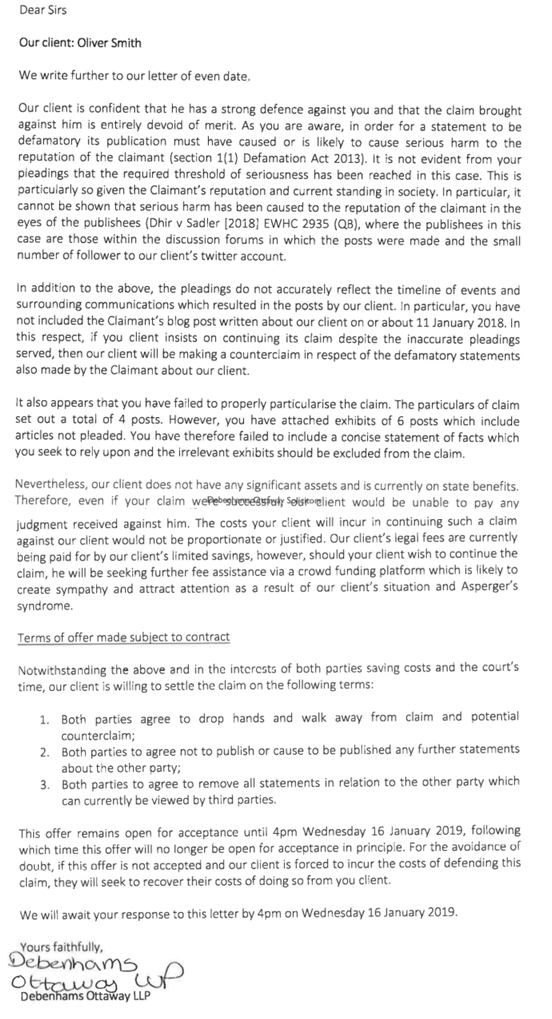
Aside from my honest opinion defence—my posts were unlikely to meet the threshold of “serious harm” required under the Defamation Act 2013 (Section 1); and Kirkegaard provided no evidence my posts caused him reputational damage. Additionally, I found a procedural error in Kirkegaard’s statement of case. In his claim form and exhibits of my posts, he was suing me for six posts (outlined previously in his letter before claim); but his particulars of claim that accompanied his claim form only set out four of these posts. This blunder meant that he could not add the other two posts (a blog post37 and a tweet), unless he got consent from me (as the Defendant), or permission from a judge to amend (his particulars), since he had already served the particulars to me (CPR 17.1).
Kirkegaard did not amend his particulars of claim since I did not consent and I would oppose his application for permission. He proceeded to sue me for only four of the six posts. This blunder is more evidence his claim was frivolous (his solicitor did not even bother to proofread the particulars before filing). Kirkegaard ignored my letter asking him to discontinue his frivolous claim and both of us walk away from litigation. I filed an acknowledgement of service, but instead of filing a defence, I applied for a hearing on the preliminary issues. I did this based on two recent judgments by Justice Nicklin in which he emphasised it was sensible to do this early if meanings were in dispute.38 Kirkegaard agreed to a hearing to determine meanings of my posts (under PD 53B 6.1).
In my letter, I highlighted Kirkegaard’s particulars of claim “did not accurately reflect the timeline of events”. By this, I meant he omitted to mention he provoked me before I wrote the six (four) posts; he sued me for writing. For example, he created a webpage about me, that is a diatribe with a plethora of lies and slurs.39 This was before I wrote any of my posts. After my solicitor disclosed the correct timeline, Kirkegaard reduced his claim for damages. Awards for damages are often mitigated if a claimant provoked a defendant into writing the publication they complained of.40 I did not expect to lose the libel lawsuit so there was no need to dwell on the mitigation of damages, however, in the unlikely event I lost and did owe damages this is something I could fall back on.
My solicitor in the letter touched upon a libel counterclaim given the severity of some of Kirkegaard’s untrue accusations about me on his website (I am not repeating them). I did not though file a libel counterclaim because I did not file a defence. According to CPR 20.4(2)(a): “[A defendant may make a counterclaim against a claimant] without the court’s permission if the defendant files the counterclaim with the defence”, but if not filed with a defence, a defendant can only file a counterclaim “any other time with the court’s permission”. This meant I would have had to apply for permission which might not have been granted, so instead I later filed a separate claim of civil harassment (see below) [KB-2024-00072] which for all intents and purposes was same as a counterclaim.
Misuse of Private Information
The above quoted letter I have decided to make public,41 but in May 2019, Kirkegaard uploaded a snippet of text from this letter to his website, without permission from my solicitor, whose email had a disclaimer: “Do not use, copy, or disclose the information contained in this message or any attachment”. Like his earlier doxxing (of my ISP) this was misuse of private information. The snippet of text (private at the time) Kirkegaard uploaded, selectively quoted a few lines of text that included “I do not have significant assets and is currently on state benefits”. While true, I worked the previous decade (as a volunteer) at: The Postal Museum, London Metropolitan Archives, British Museum, Museum of London Archaeology (Thames Discovery Programme) and my local library.

I have been intermittently, but not always unemployed. From November 2019 to about January 2023, I was employed by Royal Mail. However, it is true during most of 2019, I was receiving Jobseeker’s Allowance (£317 a month). That year, I was also studying for a Master’s degree in Classical Studies at The Open University. I had few bank savings because I spent thousands on university fees. This explains why I relied on alternative methods to pay my legal costs including money from a private donor and a crowdfund. All of this information was disclosed to Kirkegaard in confidence but in bad faith and to disparage me he posted this information. I asked him to delete the letter snippet he uploaded on his site but he refused. This was his second time of breaching my privacy.
Adjourned Hearing
I applied to strike out Kirkegaard’s statement of case under CPR 3.4(2)42 as well as the hearing on preliminary issues (my applications were intended to be heard on the same day) which were listed on 22 May 2019 before Justice Warby but adjourned because of a procedural mistake that resulted in costs (£6,978) being awarded to Kirkegaard since the careless error was my solicitor’s.43 On 6 June 2019, I applied to vary the order44 to pay him monthly installments, but because of a court backlog my application was not listed for many months. Kirkegaard filed an application on 20 June 2019 to contest my application on the grounds of an “unless” order for non-payment.45 Both applications on costs were listed at the same hearing before Master Eastman on 17 December 2019.
By the time of the costs hearing, I had won the relisted hearing on preliminary issues and was awarded costs (£13,500) so we could simply do a costs set-off (CPR 44.12) and the hearing was vacated. I filed a complaint, against the law firm I hired (Debenhams Ottaway) with the Legal Ombusdman and requested they reimburse the costs I had to pay Kirkegaard (£6,978), as well as money I spent (including my barrister’s fees) on the vacated hearing on costs applications (£5,474)—the Legal Ombusdman, decided in my favour that the service of the firm was unreasonable and ordered Debenhams Ottaway to reimburse my legal costs; awarded £750 compensation for disruption caused and an additional sum (£201.60) including the VAT. In total, I was paid the amount £13,403.60.

Preliminary Judgment
A consent order was issued on three preliminary issues:
The meanings of the statements complained of;
Whether the statements are defamatory of the claimant at common law;
Whether the statements are statements of fact or opinion.
I disagreed with Kirkegaard on all these core issues. Kirkegaard pleaded my four posts were “statements of fact” that meant he is a “sexual abuser of children” and they were defamatory at English common law. In sharp contrast, I argued they were my opinion; that meant he is a “paedophilia apologist” and doubted if they were defamation under common law which should not be confused with the statutory Defamation Act 2013.46 For a statement to be libel there are two hurdles to pass: common law and statute law. The former threshold is lower-bar,47 than the statutory requirement of “serious harm” (damage to reputation). However, the hearing on preliminary issues was not to decide if my four posts damaged Kirkegaard’s reputation since that was to be decided at trial.
When determining the meaning of a statement if it is defamatory at common law or if it is a fact or opinion, “No evidence, beyond publication complained of, is admissible” (Koutsogiannis v The Random House Group Ltd [2019] EWHC 48 (QB) at [12]). Not only do words complained of have to be taken into account but whole publication (Greenstein v Campaign Against Antisemitism [2019] EWHC 281 (QB) at [15]). This means, for example, that if someone sues someone for libel for a single sentence in a newspaper article the entire article has to be considered to understand the context of the words complained of. This would certainly be in my favour since Kirkegaard omitted large parts of text I wrote and in his particulars selectively quoted few lines from much longer comments.
Also in my favour was hyperlinks in three of my posts; the tweet was free-standing but was responding to a thread of tweets (now deleted48). The significance of hyperlinks is they are an exception to the rule; they are admissible (as evidence) beyond publication: “Where hyperlinks are provided in an online article, there is no reason to exclude that contextual material” (Greenstein, ibid., at [18]). They remain the only extrinsic evidence (outside of the publication) that a judge will look at. In terms of determining meaning, what must be determined is the “natural and ordinary” meaning of words complained of in a particulars of claim. In other words, what the “hypothetical reasonable reader” would understand the words to mean from the publication (Koutsogiannis, ibid., at [11]).
The adjourned preliminary hearing was relisted (before Justice Julian Knowles) on 26 November 2019 and my solicitor had instructed a barrister from 5RB to represent me. Kirkegaard was also represented by a barrister. The hearing went ahead this time and a draft judgment was issued on 3 December 2019 (made public on 11 December 2019). Kirkegaard lost on two of the three issues; Knowles was clear: “I reject the Claimant’s submissions and accept the Defendant’s [Oliver D. Smith’s] submissions” (Kirkegaard v Smith [2019] EWHC 3393 (QB) at [57]). Knowles recognised that my four posts were my opinions (not statements of fact) and three posts were based on hyperlinked material; including sources that paraphrased (or quoted) Kirkegaard’s blog posts on child porn.
Knowles criticised Kirkegaard for taking my posts out of context (Kirkegaard, ibid., at [63]) by ignoring the hyperlinks and for not taking into consideration the entire of the publications to determine their meanings; the words complained of in his particulars were highly selective and omitted lines of text that provided crucial context. Knowles determined my four posts,49 did not mean Kirkegaard is a “sexual abuser of children” but an “apologist for paedophilia” who supports legalising (animated) child porn; this was obvious to anyone who read the whole of my posts (rather than quoting them out of context like Kirkegaard did). It was something I pointed out at the beginning of the litigation and is yet more evidence his claim was frivolous and based on contextomies.
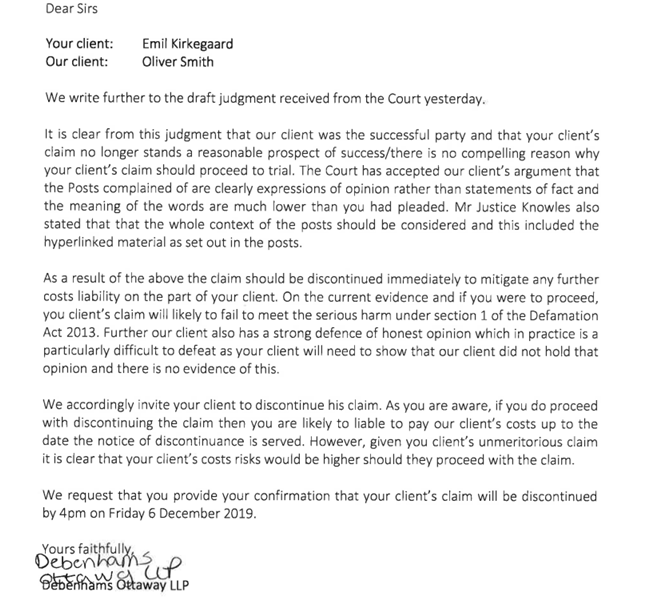
Knowles cautioned he was not determining the question of “serious harm” (Kirkegaard, ibid., [62]) but the fact he determined my posts meant Kirkegaard was an “apologist of paedophilia” not an imputation he is a child sexual abuser (nor suggested he commits CSA), meant that my four posts were unlikely to meet the “serious harm” prerequisite for defamation (under the Defamation Act 2013); this is because none of the meanings of my posts would meet the three ‘Chase levels’.50 On 4 December 2019, I sent a letter to Kirkegaard asking him to discontinue his claim (see above). His frivolous claim was proven to be unmeritorious; and he was wasting the court’s resources and my time. It was therefore clear if I filed the defence of honest opinion this would easily be upheld.
The only issue Kirkegaard won on was that my posts were defamatory at common law but it should be noted although I disagreed, this did not form part of either my oral or written argument (submissions) at the hearing. I instead focused on the other two core issues which I was successful. Those issues were a ‘stepping-stone’ to establishing my defence (honest opinion). Knowles determined my four posts were opinions with three based on hyperlinked material, meaning the conditions to establish an honest opinion defence were already met for three of my posts (under Section 3 of the Defamation Act 2013). In light of Knowles’ ruling, Lord Justice Dingemans realised that: “Kirkegaard’s action for libel was very likely to fail”51 (Smith v Kirkegaard [2024] EWCA Civ 698 at [8]).
Several of Kirkegaard’s friends ranted about Knowles’ decision online; they could not understand how he determined my posts meant Kirkegaard is a paedophilia apologist if I called him a paedophile. However, Knowles was by no means unique in his ruling. In a slander case, Oliver v. Duffy [2024] EWHC 2590 (KB) [the “Oliver” was not me]; the judge ruled that the defendant’s use of the word “peedo” [sic] meant a “dirty old man” (who “subjected younger women to unwelcome sexual interest”) and not “paedophile” (who “has a sexual interest in children”). Context matters in defamation claims and it is clear when reading my posts in context of the whole publications, and hyperlinked material (not omitting text) my posts meant Kirkegaard was a “paedophilia apologist”.
Interim Costs Order
Kirkegaard lost an interim costs order (10 December 2019) and was ordered to pay 50% of my legal costs for losing the preliminary hearing (£13,500). My submissions on costs emphasised that I won two out of three of the core preliminary issues and Kirkegaard should be expected to pay my costs. Knowles agreed and awarded me half of my costs. Kirkegaard’s submissions on costs were absurd; despite he lost on 2/3 of the issues and the judge criticised him for taking my posts out of context and clearly agreed with my meanings of the posts; he claimed the determined meanings were somehow “closer in meaning to that advocated by the Claimant than the Defendant”. This is demonstrably false to anyone who reads the judgment (Kirkegaard v Smith, ibid., at [61], [65], [68], [71]).
After ordered to pay my costs, Kirkegaard filed an application to vary the order to pay monthly installments. I applied under CPR 44.12 to set-off the two costs orders and he owed the net-balance (£6,522); my application and Kirkegaard’s were both listed before Master Eastman but owing to a backlog, a hearing was not scheduled until 2 June 2020 and the costs order awarded to me, was not sealed until 10 March 2020. To complicate things, Kirkegaard’s application did not make sense. He claimed he could not afford to make the £6,522 payment as a lump sum but his application said he had £3,000 savings and a monthly income of £6,000. This meant he could almost certainly pay me the sum immediately; his finances do not show he could only afford to pay month installments.
In response to Kirkegaard’s dodgy application (which appeared to be another abuse of process), I applied for an “unless” order to strike out his statement of case under CPR 3.4(2)(c). Kirkegaard’s application to pay by monthly installments was unlike my own; I honestly could not afford to pay him £6,978 (so applied to pay monthly installments) as my income at the time was £317 and I had £950 savings. Kirkegaard seems to have lied in his application and because he signed a statement of truth I could file for contempt proceedings (CPR 32.14). Kirkegaard later admitted to making an “error”. It is difficult to prove contempt of court in this sense (it must be an intentional false statement) and it was not worth my time trying to prove he lied since he would say he made a mistake.
Summary Judgment
Kirkegaard was given permission by the court to amend his particulars of claim after the preliminary judgment (to update the meanings of my four posts). He amended his particulars and I was given a deadline to file my defence. However, a defence was not necessary. I filed for summary judgment under CPR 24.3(a), on grounds his claim had no reasonable prospect of success (there was no need to file a formal defence and the claim to go to a trial). An application was filed (on 26 March 2020) and it emphasised my honest opinion defence and my four posts were unlikely to meet the threshold of “serious harm” under Defamation Act 2013 (s. 1). It was listed on same day as my two outstanding applications, to set-off the costs orders and an unless order (2 June 2020).
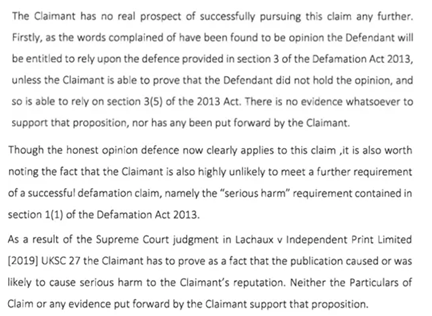
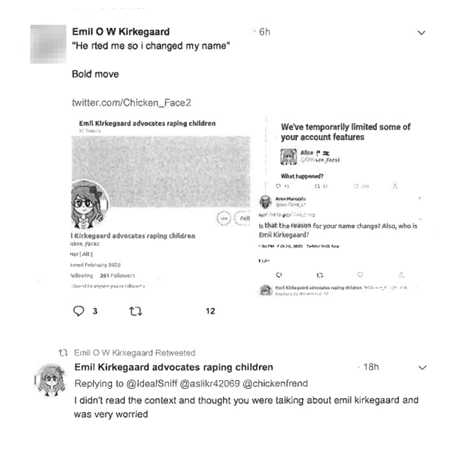
My solicitor was monitoring Kirkegaard’s social media account during litigation and found evidence disproving Kirkegaard’s claim my posts had damaged his reputation; this was submitted as evidence. Despite claiming in his particulars of claim (with no evidence at all) my posts damaged his reputation and caused him mental anguish, my solicitor found Kirkegaard was posting and retweeting content saying he “advocated raping children”. This suggests he lied in his particulars, to say the least. Screenshots from his social media account reveal he retweeted he “advocates raping children”. He did not come across as distressed by this tweet, casually retweeting it, to give it more clicks and responded by writing “bold move” (at no point did he deny the accusation).
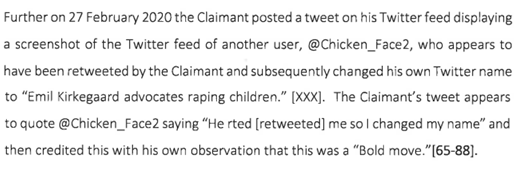
I got the impression Kirkegaard’s own solicitor was embarrassed by this since on one hand Kirkegaard (in his amended particulars), was claiming my posts that meant he is a paedophilia apologist damaged his reputation and he was distressed by them; on the other, he was casually retweeting “Emil Kirkegaard advocates raping children”. About a week before the hearing on summary judgment—Kirkegaard discontinued the claim (see below) obviously realising he was going to lose. If the summary judgment hearing had gone ahead a judgment would have been published which would have been rather humiliating for him. In the public interest, I am posting the screenshots and evidence exhibited in my application. These prove that Kirkegaard’s claim was always frivolous.
Discontinuance and Costs
On 11 May 2020, I wrote to Kirkegaard requesting again he discontinues his claim; he eventually agreed on 21 May 2020, and filed a notice of discontinuance. Although I do not have permission to post Kirkegaard’s letter response, he finally admitted his claim was bound to fail (he also conceded this in his previous letter and my letter mentioned the fact: “your client now understands that their claim no longer holds any merit”). By filing a notice of discontinuance this vacated the hearings on 2 June 2020 and entitled me to my costs (under CPR 38.6) meaning Kirkegaard was liable to pay. On 8 July 2020, I served to Kirkegaard my bill of costs (£22,906.12). Kirkegaard disputed the bill hence there was detailed assessment on costs and I hired MRN Solicitors for the assessment.
Kirkegaard filed a points of dispute and made monetary offers to settle; £8.315.20 and £11,500 but I rejected these as too low and made a counteroffer: £18,500 (plus interest and costs of assessment [about £550]). He refused but concessions slightly reduced the bill to £22,536.32. After I filed my replies to his points of dispute, the costs assessment (on papers) would have to go a provisional assessment since the costs were not agreed. The coronavirus pandemic delayed proceedings by almost a year. On 22 July 2021, the assessment was assigned to deputy costs judge Dr Mark Friston; and took place on 17 August 2021. I won the assessment and was awarded £19,317.52 (84% bill), and beat my own offer (£18,500). I was further awarded costs of the assessment under CPR 47.15(5).
The costs judge ruled heavily in my favour, partly based on Kirkegaard’s unreasonable behaviour since costs are determined on the “conduct [of the parties] before, as well as during, the proceedings” (CPR 44.2(a)). My solicitor had highlighted Kirkegaard’s poor conduct in the replies to his points of dispute and concluded by saying the: “Claimant is the author of their own misfortune and must now accept liability for the additional costs incurred as a result of his conduct”. Kirkegaard wasted five months of the court’s resources and my time; he should have discontinued soon after he lost the preliminary judgment, but instead between January and May 2020; he made me incur thousands in costs on unnecessary applications (including my application for a summary judgment).
By the time Kirkegaard had lost the provisional assessment on costs, he was a litigant in person. He filed a notice of change (months earlier) on 11 February 2021, to state he was no longer represented by a solicitor and was representing himself. The notice was void and improper because a litigant in person must provide an address (on the notice) in the United Kingdom. Kirkegaard wrote an address in Denmark (Viborg). According to PD 42 2.4:52 “A party who, having conducted a claim by a solicitor, intends to act in person must give in the notice an address for service, that is within United Kingdom.” Furthermore, The King’s Bench Guide notes: “A litigant in person must give an address for service in England or Wales” (p. 23). Kirkegaard’s notice did not comply with rules.
Kirkegaard did not challenge the provisional assessment on papers so on 7 September 2021, I applied to the Senior Courts Costs Office for final costs certificate (£26,686.43). This sum included the award from provisional assessment as well costs of assessment, drafting the bill of costs and my successful Part 36 offer since the court awarded more than my offer at the provisional assessment (this added 10% [£1,931.75]). Additionally, I added interest (£2,563.24) bringing the total sum to: £29,249.67. On top of this amount, Kirkegaard still owed me the net-balance of £6,522 from set-off of the two earlier costs orders. I filed a set-off application to be dealt with on papers, since the earlier hearing (on 2 June 2020) was vacated because of discontinuance.53 In total, he owed £35,771.67.
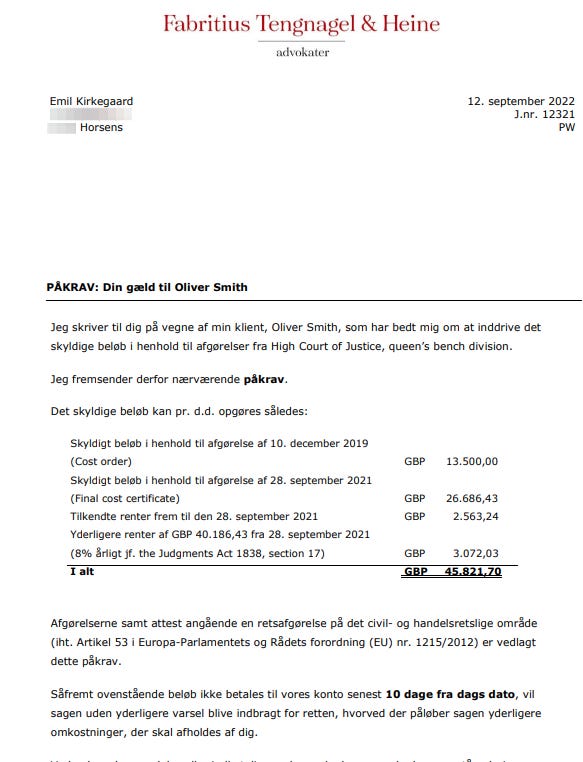
On 28 September 2021, the final costs certificate was issued. I added a ‘penal notice’54 to the order and posted it to the address in Viborg, Denmark that Kirkegaard wrote on his claim form (7 December 2018) and notice of change (10 February 2021); the address is public and is on Kirkegaard’s OpenPsych website (screenshot). I have not disclosed it here to prevent an accusation of doxxing. Kirkegaard had two weeks to pay me, but he predictably failed and breached the separate costs order (£6,522). My attempts to serve Kirkegaard at the Viborg address were unsuccessful. I got notification from PostNord that the home owner of the address was refusing delivery and Emil Kirkegaard did not reside there (“recipient not at address”). In October 2021, I became a litigant in person.
Kirkegaard does not reside in England or Wales, but I applied for a writ of control and requested his address, to be registered on the Registry of Judgments, Orders and Fines (which can record foreign addresses although his was not recorded). I did this since he could have relocated to London; he occasionally visited and still has business interests in the capital. I found a London PO Box he was briefly associated with, but service did not come to anything since I could not enforce the costs orders (based on only a postal box; nor was it registered in his name). I found at least three addresses he resided at in the US (2018) but he moved from these apartments years ago. London and the US were therefore a dead end for enforcement and I was left with skip-tracing him in Denmark.
False Address on Claim Form
In January 2022, I initiated enforcement proceedings against Kirkegaard in Denmark and also began drafting contempt proceedings in the High Court of Justice for a false address on his claim form. However, before I could file the latter I needed proof. This led me to hire a private investigator (CIS Gruppen) and an attorney who specialises in debt recovery in Denmark (Fabritius Tengnagel & Heine). Kirkegaard was easy to skip-trace since although evading and failing to pay the judgment debt his WHOIS domain records for his own website (emilkirkegaard.dk) were publicly accessible. As a domain registrant, he voluntarily made his registration details (including his address) publicly accessible and I therefore bought a domain report for his website from DomainTools.
Based on information he provided from 2010-2016, Kirkegaard was residing in Aarhus (this makes sense because for these years he was a student at Aarhus University but he dropped out of his Master’s degree). In 2017, he stated that he was living at an address in Viborg. I managed to confirm this is his mother’s house; the same address he wrote on his claim form and notice of change. In 2018, Kirkegaard wrote on his blog, that he was residing throughout 2018 in the US such as New York and DC, but did not update his domain records to reflect this. In 2019 to early 2021, Kirkegaard updated records to state he was living in Horsens (Denmark). I managed to confirm he was residing at the house of his friend Nima Brodersen Talebi.55 In May 2021, he moved to Kiel, Germany.
My attorney verified Emil Kirkegaard left Denmark to Germany by contacting the Det Centrale Personregister (a national register and database established in 1968 that stores information—such as name, address, and birthdate—for everyone living in Denmark). The CPR revealed from municipal records that his last address was in Horsens and he moved to Kiel, Germany as well as legally changed his name to William Engman. Note that he was obliged to inform me of his change in address (under CPR 6.24), so I could serve him the final costs certificate at an address he actually resides, but this is one of multiple civil procedure rules he violated. There is proof that Kirkegaard wrote a false address on his notice of change (10 February 2021) and clearly lied about his residence.
As for the address on his claim form (7 December 2018) evidence suggests Kirkegaard wrote a false address. According to CPR’s six month rule: “If you stay abroad for more than six months, you must be registered in the CPR as having left the country, even if your residence in Denmark is fully available to you”. The question remains, is whether Kirkegaard’s stay abroad was for a consecutive six months or more which would mean the Danish address in Viborg, he wrote on the claim form was invalid. I searched Emil Kirkegaard’s social media accounts for the year 2018 to find he was almost certainly in the US for over six months. In February 2018, he visited Philadelphia (tweet); for much of the year was “living in New York” and in November 2018 in Washington DC (tweet).
I presume the main reason for Kirkegaard providing a false address on the claim form was to prevent me applying for security for costs (CPR 25.28). This compels a claimant to pay money into court as a guarantee to cover a defendant’s costs if they lose. Before the UK left the European Union that had taken effect on 31 December 2020, claimants from other EU states (including Denmark), were protected from security for costs, due to there being reciprocal enforcement rules under Brussels I Regulation (recast); these protections were removed after Brexit. Kirkegaard was residing in the US, but wrote a Danish address since he likely knew I would apply for security for costs if he wrote an address in America. Another reason for the false address, was to impede enforcement.
Enforcement in Germany
After discovering Kirkegaard moved to Kiel, Germany, I initiated enforcement action there by hiring a German attorney (advoprax AG). Unlike in Denmark, I could enforce the judgment debt because I now had an address he was residing. Although the UK is no longer an EU member state, the Brussels I Regulation (recast) continues to apply to enforcing judgments in England and Wales legal proceedings, in other member states which had started before 31 December 2020; meaning before the end of the transition period (Section 2(a) of Article 67 of the Withdrawal Agreement). There are no required exequatur proceedings meaning the debt collection process is simple.56 I thus applied to the FPS for an Annex I certificate (under Article 53, Regulation (EU) No. 1215/2012).
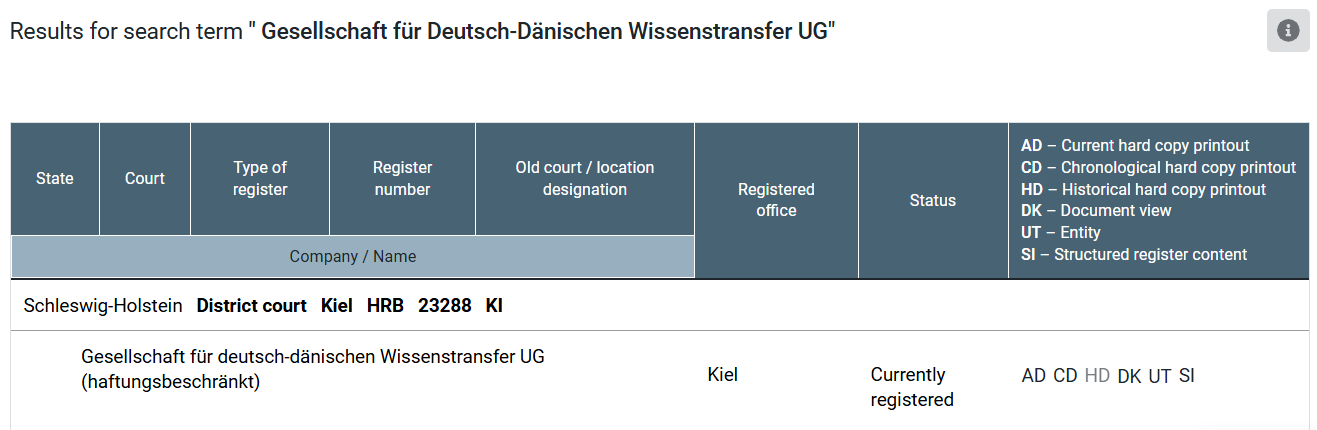
My attorney served a letter before claim and copies of the costs orders he breached to Kirkegaard’s address in Kiel. We confirmed he lived there or was at least registered as living there after contacting the German registration authorities’ database (schleswig-holstein.de). Kirkegaard failed to respond to the letter and removed his name from his door or mailbox to complicate service of further documents.57 He then moved address to evade mail service but left the same address registered to a company (Gesellschaft für Deutsch-Dänischen Wissenstransfer UG) on the commercial register at the District Court of Kiel (HRB 23288 KI), allowing my enforcement to proceed. I then served him under the German Commercial Code (Book 1, Division 2, s. 15a) using service by publication.
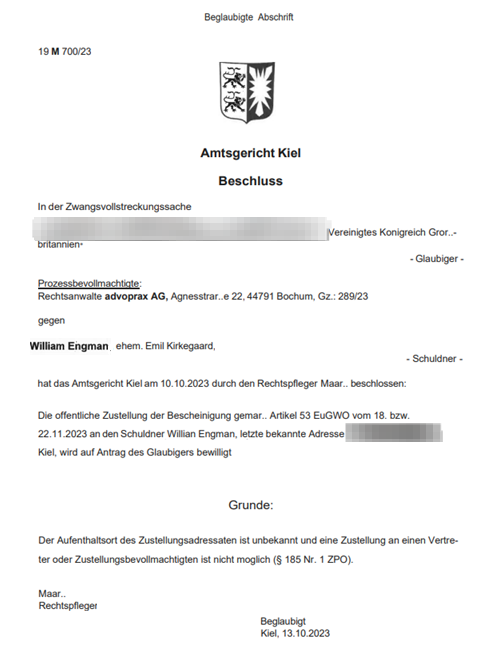
After a delay in the proceedings because I had to obtain permission from the Regional Court of Kiel (Landgericht Kiel) since the debt exceeded €5,000—the District Court of Kiel (Amtsgericht Kiel) approved my enforcement application and on 10 October 2023, the publication was put on a noticeboard inside the courthouse. After service, I looked at the possibility of garnishment of company shares and I managed to obtain a seizure order (Pfändungsbeschluss). I was though advised against seizing company assets (since Kirkegaard’s share capital was under €500). This meant enforcement action was a dead end in Germany. I did not know where Kirkegaard secretly moved to; I could not apply for a garnishment of his savings because I did not know his bank account in Germany.
Prior to dropping my enforcement case in Germany, a court-appointed bailiff from the District Court of Kiel was in charge of trying to enforce the seizure or garnishee order against Kirkegaard’s company shares. A bailiff in Germany is a public official (or civil servant) who acts on behalf of the state; the enforcement process in Germany is highly bureaucratic and I found it to be too slow. The bailiff who worked on my case, did not achieve anything and Kirkegaard evaded their service attempts. If you are a creditor in Germany, I would not recommend using a bailiff, but an alternative dispute resolution (out of court) by hiring a debt collection agency that can assist with negotiation and/or arbitration. For small debts, there is the option of the ‘dunning procedure’ (see below).
Danish Bank Account
Kirkegaard soon slipped up. Although he managed to evade me, by moving address in Germany and hid from me his German bank information, I discovered he mentioned a Danish bank account in a blog post. He posted his bank (Nordea Bank Danmark) with IBAN number (screenshot). I re-hired my Danish attorney in January 2024 and he filed a bailiff requisition (essentially a third-party debt order) against the bank account. It is probable that Kirkegaard did not realise I had the jurisdiction to file against him, even though he no longer resided in Denmark. This is because the assets (bank account) are located in Denmark so the Danish bailiff’s court (Fogedretten) still has jurisdiction over those monetary assets (regardless of Kirkegaard not having an address, in the country).
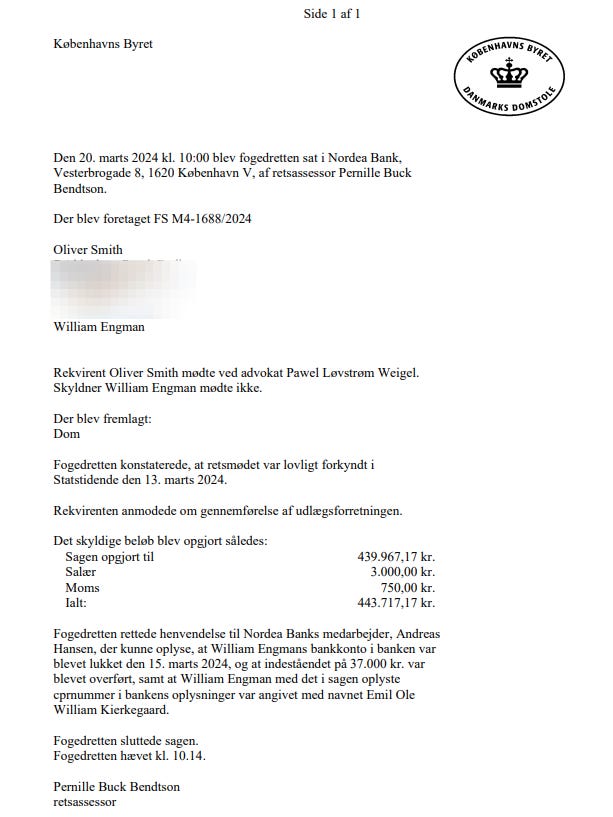
Kirkegaard did not have an address (for mail) in Denmark so I was granted permission to serve the bailiff requisition to him by email and service by publication. The bailiff’s court was at the Copenhagen City Court (Københavns Byret). Nordea Bank Danmark’s headquarters are also located in Copenhagen. Emil Kirkegaard on 13 March 2024, was served a summons (by publication) in the government gazette Statstidende (screenshot). He was summoned to attend a hearing (concerning my bailiff requisition) on 20 March 2024. Within two days of the summons being issued—Kirkegaard transferred his bank savings (37,000 DKK = £4,240) and closed his account. He refused to attend the hearing and breached the summons. He had transferred his savings before I could freeze them.
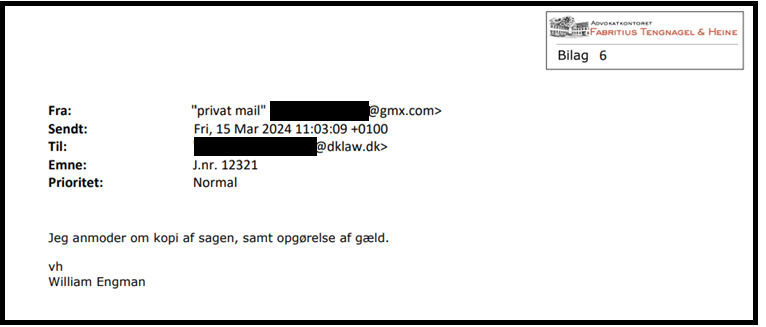
Immediately before transferring his bank savings and closing his account, Kirkegaard contacted my Danish attorney by email, to request a copy of the enforcement case and a statement of the debt owed. My attorney provided this information. Kirkegaard used an email account from GMX Mail (a German webmail service). Years later, Kirkegaard lied in a witness statement (see below), to deny sending this email. The reason for this deception later became clear: Kirkegaard preposterously maintained that he never had been served any legal documents and had no knowledge at all of enforcement as a new evasion strategy. This contradicted his contact with my attorney by email, so he began denying he sent the above email and claimed he has “never responded” to my attorney.
Villa Adlon and Mathilda Huss
Aside from Kirkegaard’s web of lies and deceptions to obfuscate service, I had to deal with him moving address to avoid enforcement. After he left his address in Kiel, I was informed by a journalist that he was sighted on the grounds of the Villa Adlon (a villa in the district of Potsdam). In December 2023, the German online newspaper Die Zeit reported Emil Kirkegaard was living on the grounds of the villa and was embroiled in yet another scandal. I hired a private investigator who confirmed to me he was at least visiting the guesthouse near the villa. The guesthouse’s mailbox was in his girlfriend’s name (I was shown a photograph of this) and I could not serve him by post. By January 2024, Kirkegaard was no longer spotted near the villa; he was rumoured to be in Spain.
According to the article and investigative journalism by Die Zeit, the co-owner of Villa Adlon, Mathilda Huss gave Kirkegaard “free lodging” and “also supported Kirkegaard two years ago, in founding the Society for German-Danish Knowledge Transfer” (note this is the same company I months earlier had served Kirkegaard by publication in the District Court of Kiel). Huss, his business partner, seems to have given him a place (on the grounds of her villa) to stay or hide, after he deregistered from his property in Kiel. His girlfriend’s name was already on a mailbox. I was later informed that Kirkegaard’s girlfriend is Mathilda Huss’ au pair. Kirkegaard moved address again so I dropped the enforcement action, I had filed in the Potsdam Regional Court (Landgericht Potsdam).
In late 2025, Erik Ahrens a former friend and business associate of Kirkegaard fell out with him and then leaked information on his blog (screenshot). Ahrens spoke with me and told me Kirkegaard was residing on the grounds of the Villa Adlon; so there is no doubt that Kirkegaard was sometimes there (which I already knew based on the proof my private investigator passed to me). Despite this, Kirkegaard was quoted as denying he lived on the grounds of the villa in a newspaper (Der Spiegel). Eyewitness testimony and photographs prove he was on the villa grounds but it might be the case he did not reside there but nevertheless visited his girlfriend (and stayed overnights). Kirkegaard uploaded a photo of himself (on Facebook) at the front of the guesthouse near the villa.
Contempt Proceedings
Having repeatedly evaded my enforcement attempts, I filed for contempt proceedings against Kirkegaard in the High Court of Justice (CA-2023-002246). I already drafted an application, and filed it on 7 July 2023, but mistakenly failed to get my affidavit signed before a commissioner of oaths; my application for contempt of court was based on (a) Emil Kirkegaard having breached two costs orders (noncompliance and disobedience) [CPR 81.4(2)(a)], and (b) a false address on the claim form, while signing a statement of truth (CPR 32.14). My application was refused (on 23 October 2024), by Justice Nicklin based on the blunder (with my affidavit) plus my failure to serve the application (since Kirkegaard was evading service) but I applied for relief from sanctions under CPR 3.9.
On 13 November 2023, Nicklin issued an order, refusing my application for relief from sanctions and he refused to restore my contempt application. Nicklin erred in some of his reasons so I appealed the order in the Court of Appeal; on 14 March 2024, Rt. Hon. Lord Justice Warby, granted me permission to appeal. One of the obvious mistakes by Nicklin, was stating: “The Court cannot exercise its contempt jurisdiction in this case over someone who is not within the jurisdiction”. However, Warby noted in his order: “a foreigner who invokes the court’s substantive jurisdiction is subject to its contempt jurisdiction in respect of matters incidental to the claim”. He also gave me permission to serve Kirkegaard by email since Kirkegaard was evading personal and postal service.
Warby recognised Kirkegaard was evading service so personal service (direct, face-to-face delivery of documents) which is normally required for contempt proceedings was impossible. I was therefore granted permission to serve Kirkegaard by email and sent him my appellant’s notice and other documents. Kirkegaard never responded and was ignoring the contempt proceedings. A hearing took place (on 5 June 2024). Kirkegaard failed to attend but I attended in person. Judgment was made public (on 21 June 2024). I won on three out of four issues (Smith v Kirkegaard [2024] EWCA Civ 698). Firstly, my contempt application could demonstrably be brought to the ‘attention’ of Kirkegaard by alternative methods of service such as email under CPR 6.27 so I won on that issue.
Concerning issue two, Lord Justice Dingemans agreed with Warby that “CPR 81.4 has extraterritorial effect”58 (Smith, ibid., at [33]). I easily won on that issue but lost on the third issue. Dingemans rejected my argument using Australian case law,59 Kirkegaard could be imprisoned for breaching costs orders if he had the means to pay me and was wilfully disobedient. This was certainly the case because Kirkegaard had assets and an income (he disclosed to the court to have an annual salary of £72,000 [monthly income of £6,000]). Dingemans noted that: “Committal to prison for non-payment of judgment debts and debtors’ prisons were, in effect, abolished” [under the Debtors Act 1869, s. 4] (Smith, ibid., at [39]).60 Looking this up, he is correct; so Kirkegaard could not be jailed.
Despite Dingemans was correct that Kirkegaard could not be imprisoned for refusing to pay the judgment debt and breaching costs orders (one even had a penal notice), he appears to have overlooked I did not only ask in my application for committal (to send Kirkegaard to prison). Under CPR 81.9, there are different punishments (for contempt) including “a fine, confiscation of assets or other punishment permitted under the law” (contempt of court should not be confused with committal since the former includes a broader range of punishments than prison). It is puzzling, why no fine was imposed.61 I thought about appealing the judgment (on the third issue), in the UK Supreme Court on the basis a fine should have been imposed but did not have the costs for the appeal.
Interestingly, an academic paper “Contempt and Committal in Smith v Kirkegaard” in the Civil Justice Quarterly by the barrister Matthew Hoyle (2024) has argued Dingemans was mistaken since he used the “wrong statutory footing”. Hoyle agreed with my view a fine (on Kirkegaard) should have been imposed and concluded by saying: “the Court of Appeal clearly fell into error in refusing to grant relief from sanctions in respect of the non-payment of debts”. As for the fourth issue, I was granted relief from sanctions for the other issues and my contempt application was restored (for the false address). I corrected the error I made by not signing my affidavit before a commissioner of oaths. Dingemans sensibly advised that going forward, I should get pro-bono representation.
Overall, the judgment was devastating for Kirkegaard and revealed him to be evading service of the contempt proceedings and a recalcitrant debtor. Dingemans recognised Kirkegaard had taken, “extensive efforts to avoid service, and to ensure that his assets are not seized” (Smith, ibid., at [50]). Although Kirkegaard could not be imprisoned the judgment clarified he was in contempt of court for breaching costs orders: “failure to pay the costs may be a contempt of court, but it cannot be enforced by imprisonment for contempt” (Smith, ibid., at [44]). My application returned to the lower court and an order was issued (on 1 July 2024) by Justice Collins Rice ordering a directions hearing; the hearing on my application was listed before Richard Spearman KC on 24 July 2024.
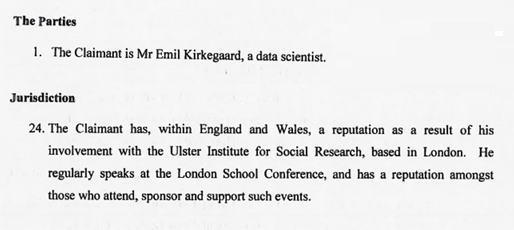
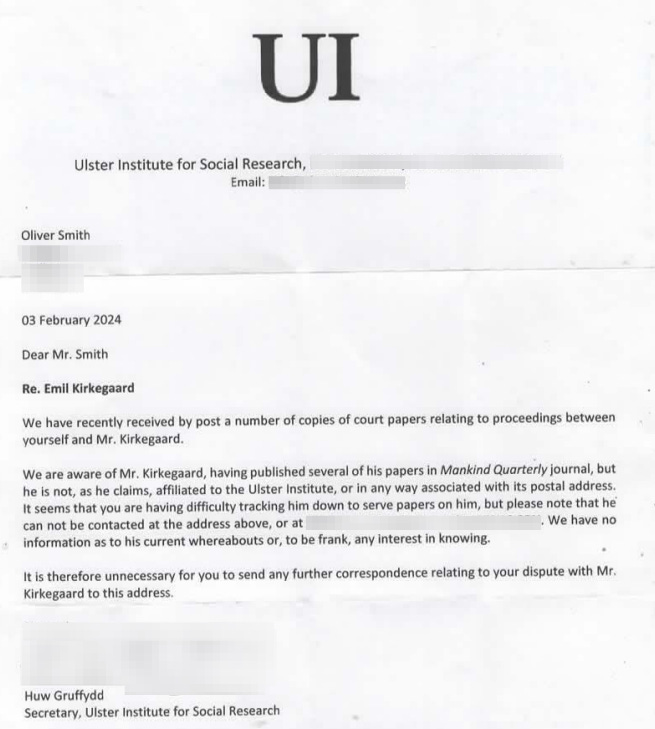
I amended my application for the hearing to add two additional claims of contempt of court—Kirkegaard described himself as a “[data] scientist” (on his particulars of claim) but he was not employed as a scientist anywhere and this appeared to be another false claim while signing a statement a truth. Kirkegaard further described himself as being affiliated or having an “involvement” with the Ulster Institute for Social Research, but the secretary of the USIR mailed me a letter (see below), asserting Kirkegaard is not in any way affiliated with their institute, after I asked. Kirkegaard misleadingly stated he “regularly speaks at the London School Conference” (I presume he meant the LCI) but failed to point out these conferences, breached the university’s room booking process.
Spearman rejected my contempt application for the following reasons:
False address: there is reliable evidence that Kirkegaard put a false address on his claim form (he was living in the US [in 2018] not Denmark) but Spearman thought Kirkegaard could have made a “mistake” and this was not sufficient for contempt (which requires deliberate falsehood62). Kirkegaard might not have known that if you have a residency in Denmark but stay abroad for longer than six months, your residency becomes invalid because the CPR registers you as having left Denmark.
Data scientist: I provided evidence that Kirkegaard had a history of exaggerating his credentials, for example, his alma mater criticised him in 2016 and he was not ever a scientist by a profession or employment. However, according to Spearman, Kirkegaard could have meant he was a “data scientist” in his spare time or he was merely a scientist in an amateur sense. I did not have proof he meant employment.
Ulster Institute for Social Research: Spearman said that the word “involvement” was ambiguous and did not strictly mean affiliation. Kirkegaard has loosely been “involved” with the USIR’s former president Richard Lynn and published papers in the Mankind Quarterly when it was previously published by the USIR. He is not though an employee or research fellow of the Ulster Institute for Social Research.
It should be realised that the required standard of proof for contempt is not balance of probabilities (in other civil proceedings) but the criminal standard of evidence, beyond a reasonable doubt; my application was therefore aways going to be an uphill struggle. Nevertheless, Kirkegaard acknowledged the fact, he was caught out lying about being a research fellow of the USIR. On his Google Scholar page (screenshot), he stated he is explicitly a research fellow as well as on some of his papers. After the hearing, I found Kirkegaard removed every mention of the USIR (as his affiliation) from his OpenPsych papers (for example, compare this screenshot from 2023, to this screenshot from 2024). Kirkegaard further replaced any mention of the USIR with “Arthur Jensen Institute”.63
Default Costs Certificate
On 21 June 2024, an order in the Court of Appeal noted the “respondent shall pay the appellant’s costs [as a litigant in person], to be the subject of a detailed assessment”. I served Kirkegaard my bill of costs (and notice of commencement). The court awarded me costs because I won the appeal, however, Kirkegaard remained unresponsive. This resulted in a default costs certificate since he did not challenge the bill within twenty-one days. The default costs certificate was for court fees and modest costs as a litigant in person under PD 46.5 3.4. These totalled £1,140.54. The default costs certificate was issued on 5 August 2024. I was given permission (under CPR 6.15) to serve Kirkegaard by email by Warby. After serving the costs order this ended the contempt proceedings.
Unlike the separate costs orders, I could not enforce the default costs certificate under Brussels I Regulation (recast) because my appeal was filed after Brexit. However, since the costs order was a modest sum, enforcement could be streamlined via the ‘dunning procedure’ in Germany. I hired a debt collection company (Evocate Inkasso GmbH) to send Kirkegaard a dunning notice (Mahnbescheid); the problem was finding his address for postal service. By this time, he was no longer spotted near the Villa Adlon (Ahrens later told me that he was temporarily living in Spain). Social media posts revealed that Kirkegaard was frequently traveling abroad so this made enforcement near impossible and by late 2024, I threw in the towel and ended enforcement proceedings in Germany.
Mankind Publishing House
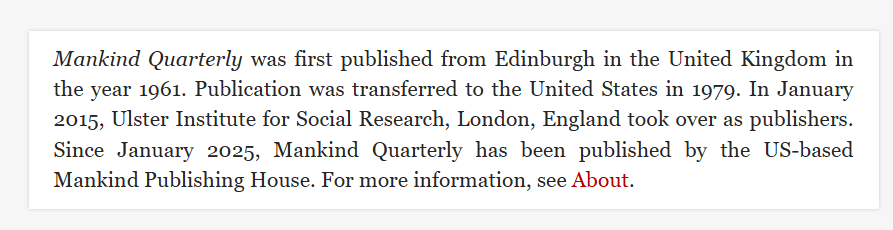
In October 2024, I discovered after reading an article (“Race Science, Inc”),64 by Hope not Hate, Emil Kirkegaard had set up a company named Human Diversity Foundation. This is an LLC he registered in Wyoming, US (he renamed the LLC Polygenic Scores). Several months earlier I found a very similar company was registered named Mankind Publishing House. The USIR was the publisher of the Mankind Quarterly (an infamous pseudoscience journal), until Richard Lynn died in July 2023. After his death, it seems Kirkegaard took control of Mankind Quarterly; and he registered a company to publish it. His Mankind Publishing House was created in February 2024—Mankind Quarterly’s website was updated in January 2025, to mention the change of publisher (screenshot).
In November 2024, I found Mankind Quarterly was offering to purchase subscriptions to the journal by PayPal. This opened up the possibility of a third-party debt order in the UK because PayPal UK Ltd is a subsidiary of PayPal Holdings Inc (the former is a private limited company in the UK with its office in London). It was clear from Hope not Hate’s undercover investigation (which was broadcast as Undercover: Exposing the Far Right) and the fact Kirkegaard is the domain registrant of Mankind Quarterly’s site that he now owned the journal. On 5 December 2024, I applied for a third-party debt order against Mankind Quarterly’s PayPal account. Within a month Kirkegaard deleted all the PayPal links on Mankind Quarterly’s website subscriptions webpage (see below).
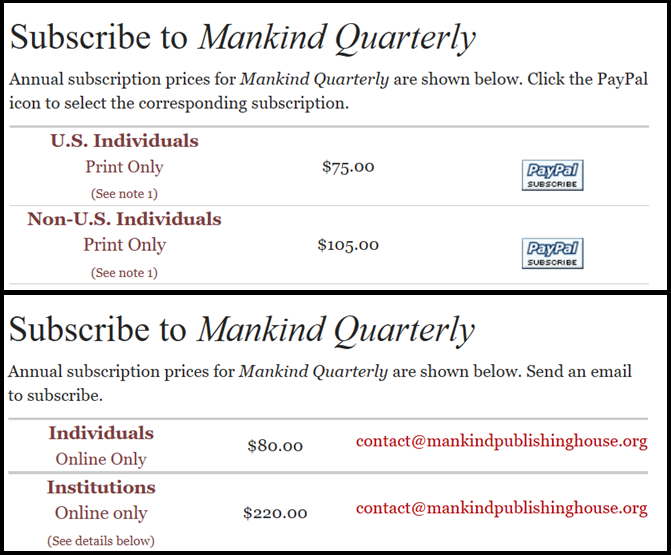
A hearing on my application, was listed before Master Eastman (on 10 February 2025). An interim third party debt order was issued on 18 December 2024; it was sealed on 13 January 2025. However, the hearing had to be vacated because Kirkegaard removed all of the PayPal links from the website and probably then transferred funds in his PayPal business account and there would be nothing for me to seize. Regardless, Kirkegaard’s use of PayPal was a violation of their policy, since they suspended his original account (and I was informed his business account was later banned). PayPal hired a solicitor to represent them. Needless to say, they were not happy with Kirkegaard’s behaviour and aside from wasting my time and a judge, Kirkegaard also wasted the time of a solicitor.
I have little doubt Kirkegaard removed the PayPal links from his site, after he found I filed a third-party debt order. This was an error of the court since I asked the court to keep the interim-third party debt order confidential like my application. By mistake it was briefly made public via E-filing.65 When I saw the interim-third party debt order publicly uploaded, I requested it be immediately removed but by then Kirkegaard had seen it. This explains why in such a short space of time, the PayPal links were deleted. The timing can hardly have been coincidence. To pay now for subscriptions, you have to be “vetted” because Kirkegaard is concealing payment options (he is cautious about who purchases a subscription) so requests subscribers to verify their identity by email.
Danish Arrest Warrant
In late 2024, I discovered by skip-tracing,66 Kirkegaard owns another bank account in Denmark (likely where he transferred his savings before closing his other account). He no longer resided in Denmark but jurisdiction was based on the Danish bank account itself (the account had a different IBAN to the account he closed). My application was filed in the bailiff’s court (Fogedretten) where the bank was located (Viborg). The court granted permission to serve by email. On 23 October 2024, Kirkegaard was summoned to attend a hearing at the District Court of Viborg. However, he unreasonably failed to attend. On 4 December 2024, he was again summoned but did not attend; this resulted in a police warrant to arrest him. I have now made this information public (see below).
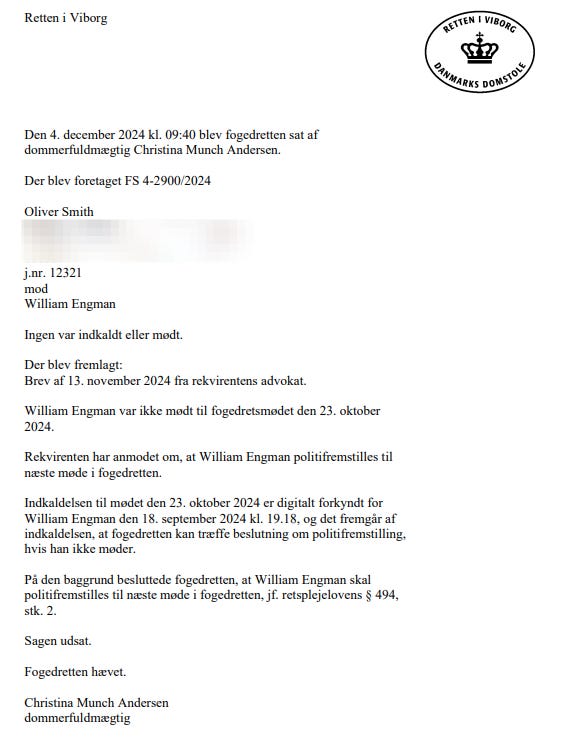
According to the Danish Administration of Justice Act (s. 494, at [2]) if “[A] debtor fails to appear, regardless of the fact that a legal summons has been served on him, without notifying the legal default the bailiff’s court can decide by order that he must be taken into custody by police until he can be produced at the bailiff’s court”.67 On 29 January 2025, Kirkegaard breached another summons but the police were unable to detain him despite conducting searches. My bailiff requisition was not solely based on his Viborg bank account but the fact there was a slim possibility that Kirkegaard had moved back to Denmark (despite he did not register this move). This is because he wrote the same address in Viborg (on the claim form) on a Mankind Publishing House company filing.
I got the police to check the Viborg address, which is his mother’s house. His mother (the homeowner), however, told police the did not reside there (the CPR confirmed he was not registered as living in Denmark and the police verified this by other records). Kirkegaard breached another summons on 19 March 2025; the court record noted: “It has not been possible for the police to detain William Engman”. After breaching four summonses (or five if the hearing in Copenhagen is included), and evading the police, a bailiff court judge likened the situation to the movie Catch Me If You Can (2002). My enforcement case had a final pending hearing which would have frozen any money in Kirkegaard’s bank account but by that point in time he reached a settlement with me.
False Document and Perjury
Emil Kirkegaard wrote the same Viborg address (on a company filing) for his ‘Articles of Organization’ (Mankind Publishing House) on 4 February 2024—with the Wyoming Secretary of State. There is proof from the Det Centrale Personregister, he was not living nor was registered at this address when he wrote it on the company filing. My Danish attorney contacted the CPR on 8 January 2024, and 4 June 2024, who confirmed he had no registered address in Denmark (he left the country on 1 May 2021). It is impossible he was residing at that property on 4 February 2024. Despite this, he filed a document to claim this was his address. On 7 April 2024, I therefore filed a sworn affidavit, with the Wyoming Secretary of State complaining about the address on the company filing.
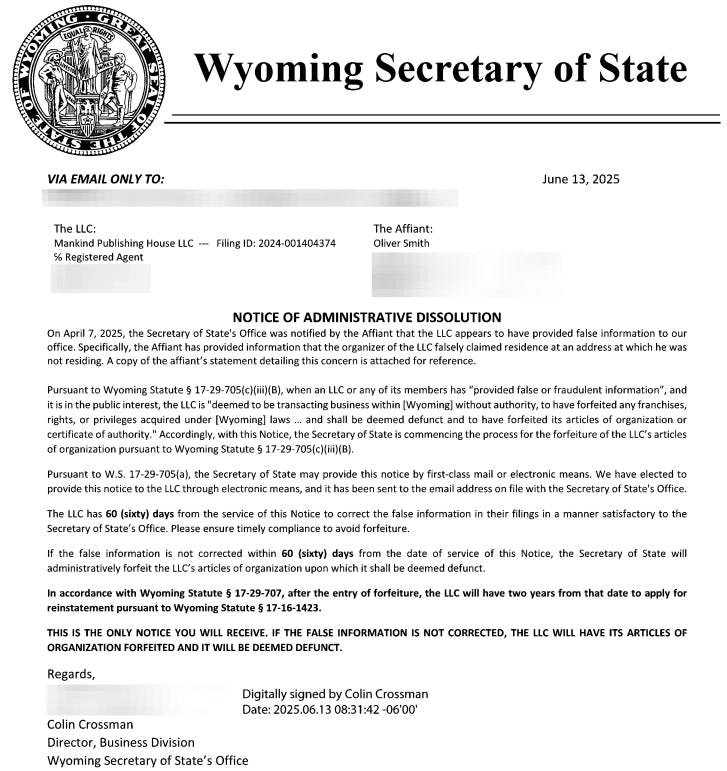
On 13 June 2025, the Wyoming Secretary of State, dissolved the company; for filing a false document or specifically providing “false or fraudulent information” (W.S. 17-29-705). The company had sixty days to correct or update the address; Kirkegaard refused to do this, resulting in the company being administratively dissolved. I requested that the Wyoming Secretary of State also ban Kirkegaard from filing any more documents; under a statute this is possible for five years (W.S. 9-1-308). The Wyoming Secretary of State appears to have taken a more moderate form of action; they “archived” Mankind House Publishing rather than allowing the company to be reinstated. Most companies that are dissolved (within two years) can apply for a reinstatement, but this was denied.
On 10 October 2025, Kirkegaard contested the dissolution of the company by filing his own affidavit (to counter my affidavit). The Wyoming Secretary of State has reinstated the company despite he did not file a formal application to reinstate. According to the Wyoming Secretary of State, they now accepted the address as a “care of” (c/o) address meaning his mother (with his permission) accepts post sent to him despite he does not reside at the property (nor is registered or doing business there). I was not informed of this until 16 March 2025. I can still dispute the c/o address but the Wyoming Secretary of State clarified “with disputed evidence, this is now a matter for the courts.” Despite being a legally interested party, I cannot myself file for a judicial court intervention.68
The Wyoming Secretary of State is not an investigatory apparatus so they did not look with great detail into my disputed evidence namely that Denmark does not apparently allow permanent c/o addresses (Danish mailboxes also require names on them and the Viborg address, does not have Emil Kirkegaard’s [or William Engman’s] name on it, so no post sent in his name will even reach his mother). The issue of address aside, I have strong evidence that Kirkegaard committed perjury in his sworn affidavit (this did not surprise me in light of the previous contempt proceedings); I was given access to read his affidavit because the filing is a matter of public record. Anyone can request a copy from the Wyoming Secretary of State, despite Kirkegaard requested it be confidential.
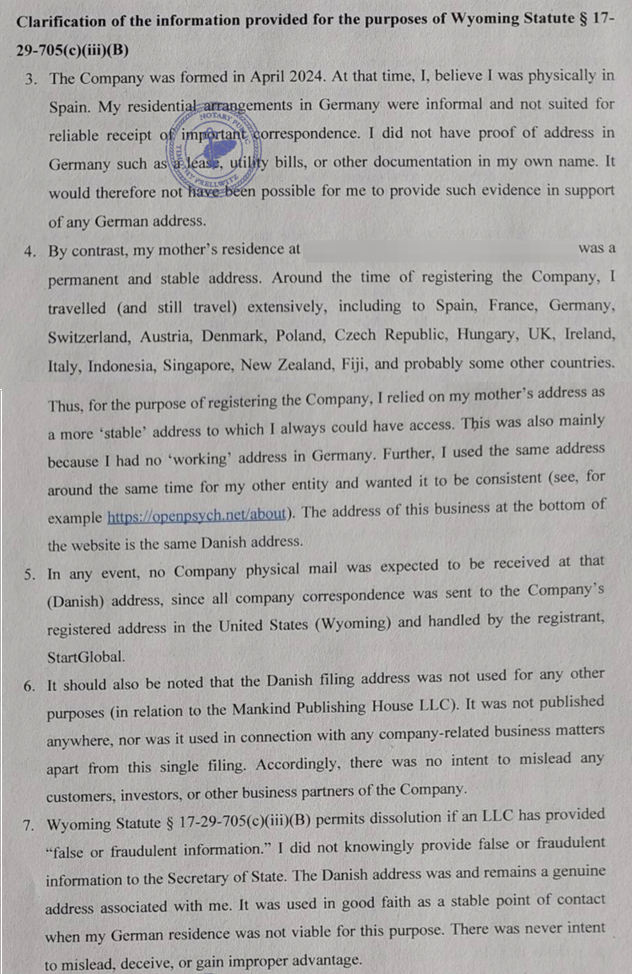
The perjury in the affidavit (see above) is transparent. Kirkegaard falsely says that his mother’s address in Viborg he used as a business address (seemingly, in an attempt to legitimise it), and insinuated it is a registered business address. However, this address is not registered with DK’s Central Business Register (Det Centrale Virksomhedsregister). What makes this worse, is Kirkegaard falsely described OpenPsych as his “business” at his mother’s address. If that was correct it would be a registered business; my attorney confirmed that OpenPsych is not registered as a business (we checked, because I could have initiated an enforcement action if OpenPsych was an actual company). The reality is OpenPsych as a business or company, is as fictitious as his “Arthur Jensen Institute”.
Kirkegaard admits to being in Spain in April 2024. It seems he relocated there in early 2024 after moving from grounds of the Villa Adlon in Germany so it appears he moved temporarily to Spain shortly after his location was reported in Die Zeit. He also admits the address on the company filing was not his own but his mother’s (the CPR confirms he was not registered as living there) but claims it was a c/o address: “The address was and remains a genuine address associated with me.” He omitted to mention why he no longer had a “stable” address in Germany for the years 2023 and 2024. He deregistered from his Kiel address specifically to evade service of my enforcement and knew that if he registered another address in Germany I would be able to serve him so kept hidden.
I have decided not to quote the rest of the affidavit (because it contains bare opinions, unfounded allegations, and outright smears about me). Whereas I outlined the facts in my affidavit, Kirkegaard misused his sworn testimony to vilify me and make up patent falsehoods (he exhibited no evidence in contrast to my many exhibits). For this reason, and the other lies (in the affidavit), I intend to file a criminal complaint with the police (Sheridan Police Department) for perjury (W.S. 6-5-301) and filing a false affidavit with the Wyoming Secretary of State (W.S. 6-5-308). I do not want to get immersed in future civil litigation with Emil Kirkegaard (it is exhausting), but perjury is a criminal matter, and Wyoming police can now deal with it; the punishment is imprisonment and a fine.
Debtor to Attend Court
By December 2024, Kirkegaard was evading police in Denmark and I had grown weary of enforcement since he had gone to extremes to prevent me seizing his assets; all that remained was my bailiff requisition (against his bank account), but I was told the odds of recovering money by this method were small since he previously closed an account. Kirkegaard had also managed to worm him himself out of contempt proceedings so as a final resort and to get some form of justice—I filed an application for him to attend court as a debtor for questioning (CPR 71.2) in the County Court at Central London.69 He was summoned to answer questions about his income and assets by a court officer and had to do this under oath. I also wanted to ask him questions about his liabilities.
Kirkegaard was continuing to evade service. I earlier applied to serve under CPR 6.27. This was granted by Master Eastman, because the higher court (Court of Appeal) had already given me permission to serve Kirkegaard by email (because there was proof he was evading service). I served Kirkegaard and he was summoned to attend court on 23 January 2025 but shortly before the scheduled oral examination (about his income and assets) Kirkegaard got in contact with me by a direct-access barrister from Old Square Tax Chambers. I was offered a £5,000 settlement, which I declined (he owed ten times that sum, since the debt had accrued post-judgment interest70). Kirkegaard then filed an application (to vacate the oral exam), but it was filed too late for the court to vacate.
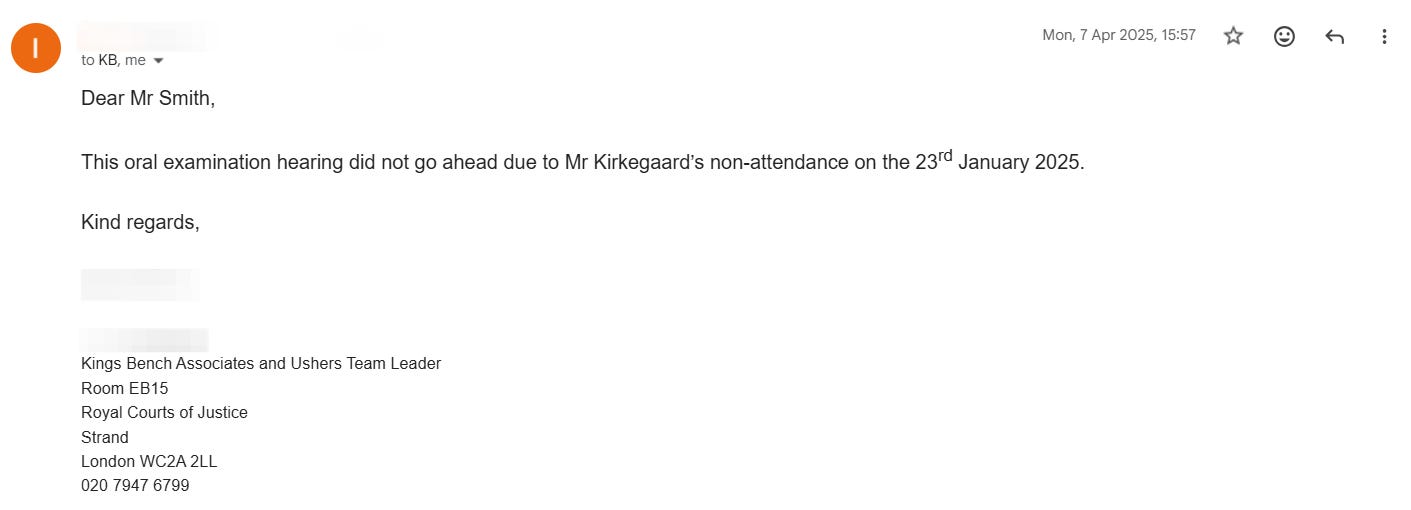
The oral exam was scheduled but Kirkegaard failed to attend in person; he instead got his barrister to attend (I attended as the creditor). This was pointless, since the debtor had to attend in person to answer questions under oath; the hearing did not go ahead. I was awarded costs (£65 court fee) for my application for his non-attendance. Debtors who refuse and fail to attend court for questioning, face a suspended committal order. This means if they do not appear at a future oral exam they can be sentenced to prison and/or the court can fine the contemnor (this is done to compel compliance). I applied for a suspended committal order (CPR 71.8). This put pressure on him to make a more reasonable monetary settlement offer or he risked getting arrested and imprisonment.
Kirkegaard did not file another application to vacate the oral examination; instead, he appealed the order that granted me permission to serve him by email. That order was issued by a master (and not a judge) so the appeal (KA-2025-000049) went to the High Court Appeal Centre rather than the Court of Appeal. The immediate thing I noticed with the witness statement that came with the application is Kirkegaard had failed to provide his address which did not comply with PD 32 18.1(2): “his place of residence”. Note that under CPR 32.8, any witness statement can be struck out if it fails to comply with the required format and procedure rules. I therefore filed an application to strike out his entire witness statement for failing to provide his address which is mandatory.
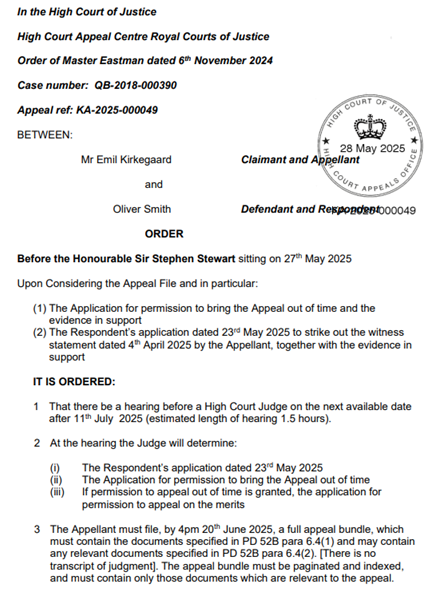
As for the content of the witness statement itself—it was apparent what Kirkegaard’s new evasion strategy was. He disingenuously pretended he had “no knowledge” of the emails I served him because he “blocked Mr Smith’s email address(es)”. This is despite glaringly contradicting himself; if he did not receive my email, serving him my debtor to attend court application why did he hire a barrister to offer me a £5,000 settlement? By claiming he blocked my emails this was an admission of misconduct because I had been granted permission to serve him by substituted service.71 The problem with this denial of service is he earlier emailed my Danish attorney (see above) but to get around this hole in his story, he lied, to bizarrely claim it was not him but an “impersonation”.
Aside from denying he was served, Kirkegaard got his barrister to make up a bunch of nonsense as part of a ‘shotgun approach’ desperately hoping one of his many dubious arguments would stick. For example, he relied on Masri v Consolidated Contractors et al. [2009] UKHL 43; in which the House of Lords held court’s jurisdiction (under CPR 71) did not extend to an officer of a company domiciled overseas. However, the officers in Masri were not parties to the original action, nor voluntarily submitted to jurisdiction of the High Court of Justice, like Kirkegaard did. It is common sense, that a party in a lawsuit (who has submitted to the jurisdiction of the court), cannot then argue against jurisdiction of the same court meaning CPR 71.2 and 71.8 have extraterritorial reach.72
There was only a single argument in Kirkegaard’s application, that was not ridiculous. My application for an alternative method of service under CPR 6.27 was made without notice (ex-parte) since Kirkegaard made personal service and postal service impossible. According to CPR 23.9(3), “The order must contain a statement of the right to make an application to set aside or vary the order under rule 23.10”, however, Master Eastman’s order (granting me substituted service) did not contain this added statement. This was an accidental omission, but in good faith, I informed Kirkegaard in an email about his right to set aside or vary the order (due process); there was an error but it was arguably remedied and it is unlikely the court would have invalidated the order under CPR 3.10.
It will be noted the order (on 27 May 2025) mentioned Kirkegaard’s appeal was “out of time”, so he applied for an extension of time to bring the appeal and he further needed permission to appeal from a judge (before being able to appeal the order). It is unlikely this would have been granted because the application was totally without merit, and I would have probably gotten it struck out anyway (for failing to provide the address on his witness statement) but the hearing on our applications never occurred because we reached a private settlement agreement, on 19 June 2025. The separate hearing on my application for the suspended committal order (listed on 2 July 2025) was also vacated; there were two other hearings cancelled, including a directions hearing (30 June 2025).
A Tomlin order was issued on 1 July 2025. Although the contents of this schedule (the terms of the settlement) are confidential, the order itself is public. As I stated near the top of this post I will not breach the terms of the settlement by disclosing information but I think anyone can take an ‘educated guess’—he paid me a five-digit amount. Why did I agree to settle? The answer is I had enough of the litigation (I was “burnt out” so to speak) having spent years on trying to recover the judgment debt which soaked up a huge amount of my time and caused me immense anxiety. If he made a sensible offer I would agree to end our legal dispute, and move on. The reason why Kirkegaard settled was different than my own; he feared consequences of the suspended committal order.
In Denmark, judgments in the bailiff’s court are not usually public and the whole time Kirkegaard evaded the police, few people knew that there was a warrant for his arrest. The situation is different in England. Judgments for suspended committal orders (and committal orders for contempt of court) are generally public. Kirkegaard knew that he would face humiliation or shame in these judgments and he did not want a suspended committal order but there is perhaps another reason he settled (after years of evasion). About a month after settling, Kirkegaard made a tweet and blog post revealing he was now a father; this suggests he settled litigation because of financial responsibilities of raising a child otherwise he was going to have to spend thousands more on legal costs.
Kirkegaard hired a direct-access barrister whose hourly rate is £325. I was in daily and copious correspondence (with his barrister) and Kirkegaard would have been billed for every letter and email his barrister sent me. There were around forty letters and over a hundred emails. His barrister worked on preparing bundles for the hearings that were vacated, as well as on submissions. He also would have charged an attendance fee (for the oral exam he pointlessly showed up to) and would have had disbursement costs. It is reasonable to estimate Kirkegaard paid about £35,000 to his barrister. I do not know if he had a conditional fee agreement (‘no win no fee’) with his former solicitor, but he undeniably had spent tens of thousands on litigation, up to the settlement agreement.
Settlement Agreement
The Tomlin order mentions that myself and Kirkegaard mutually agreed to settle all of the claims and appeals (QB-2018-000390, CA-2023-002246, KB-2024-000772, CA-2024-002547, KA-2025-000049). A brief clarification on CA-2024-002547: this was an appeal in which I obtained new evidence for contempt proceedings but I discontinued before permission to appeal was granted so there was “no order for costs” (note the court has discretion to disapply the default costs rule; under CPR 38.6 and 44.2). In other words, I did not owe Kirkegaard any costs (simply because he had none to claim). The Tomlin order notes my harassment claim (KB-2024-000772) was also settled (see below) and we agreed to vacate all the hearings in the claims and appeal, and to stay the proceedings.
Kirkegaard breached the terms of the settlement, resulting in me sending a pre-action protocol letter; he provided remedy on 30 September 2025, so I did not apply to unstay the proceedings to enforce the schedule. It is probable he again breached the schedule —in his sworn affidavit on 10 October 2025 he disclosed private information about the terms of the settlement, however, it is not worth my time (or costs) applying to ‘lift the stay’ of the proceedings to enforce terms in the confidential schedule. I do not want to be involved in litigation with Kirkegaard ever again. My last contact with his barrister was on 7 October 2025 (asking if he was coming off the court record). QB-2018-000390 is now “case concluded” on Caseboard, which updated last case activity on 1 July 2025.
Harassment Claim
On 12 February 2024, I filed a harassment claim in the High Court of Justice under the Protection from Harassment Act 1997 (Section 3). As I earlier mentioned, I did not file a counterclaim against Kirkegaard in Kirkegaard v Smith (QB-2018-000390) so later filed a civil claim of harassment Smith v Kirkegaard (KB-2024-000772). My claim for damages was for £1,000 and I requested declaratory relief.73 The primary basis of my claim was Kirkegaard described me as a “stalker” in tweets and blog posts (examples: screenshot, screenshot and screenshot [see below]). I have never “stalked” Emil Kirkegaard; this is an unfounded and malicious accusation. I did skip-trace, as well as hired a few private investigators but this was all justifiably done as a creditor to recover the debt he owed.
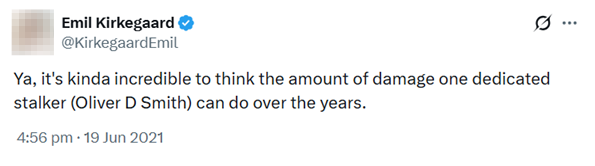
Skip-tracing is not stalking; the bailiff I used in Germany was court-appointed and my enforcement actions in Denmark that led to an arrest warrant were legal. I did not get around to filing enforcement actions in the US (only drafting them), but I was in email contact with debt collectors (who abide by the Fair Debt Collection Practices Act). To sum up, everything I did to “locate” Kirkegaard was based on a legitimate reason (debt collection and to serve him legal papers), not violate privacy protections, intimidation, or harass him. This sharply contrasts to his own behaviour: doxxing my ISP, misusing my private information and posting my twin brother’s name and birth record on social media. There is likely an element of psychological projection in his stalker accusation.
Aside from falsely accusing me of being a stalker, I received extensive abuse by emails under pseudonymous names when I was trying to enforce the judgment debt. It seems Kirkegaard was hiding behind these fake names (to avoid legal liability). He might not have realised, that the standard of proof in civil harassment is balance of probabilities and not evidence beyond reasonable doubt. I would only need to show it is more likely than not he sent these abusive emails. Who else would be taunting me about evading? I can only describe Kirkegaard’s behaviour as sociopathic: he filed and lost a frivolous lawsuit, refused to pay my legal costs, then was antagonising me about evading service under fake names sent from unsolicited emails while the same time playing the victim.
A major difficulty was serving the harassment claim since Kirkegaard had repeatedly moved address and country (at the time, he was moving between Germany and Spain). Kirkegaard was the Claimant in QB-2018-000390 so in that claim I did not need to ask the court permission to serve outside of the jurisdiction (he voluntarily submitted) but in KB-2024-000772, I had to request permission for service outside of the jurisdiction, since he was the Defendant (this process is extremely difficult for a litigant in person). I was granted alternative method of service (under CPR 6.15) by Master Gidden, but I did not follow the correct procedure for service out of the jurisdiction despite serving by email. I discontinued the claim a day after his barrister had made contact by email.
I was first contacted by Kirkegaard’s barrister (about the claim), on 17 December 2024, having received a letter by email (the letter was dated a day earlier). I discontinued the claim on 18 December 2024, so he could only claim costs (CPR 38.6) he “incurred on or before the date on which notice of discontinuance was served on the defendant”. This meant his claimed costs should have been been minimal-to-none because he only had a few days at most of legal representation. Predictably, he abused the court process to massively inflate costs. He filed a statement of costs for £3,567.50; this was absurd and included £1,877.50, for preparing the bundle and writing submissions on costs. He was disproportionately claiming more costs for his costs submissions than everything else.
Needless to say, I objected to his statement of costs and therefore filed my own on the basis his was an abuse of process and the default costs rule should be disapplied (CPR 38.6). My claimed costs were £304 (as a litigant in person); a hearing on our statements of costs (summary assessment) was meant to take place on 21 July 2025 but because we reached a settlement it was vacated. I have little doubt, I would have won that hearing if it had gone ahead but it should be noted that even if I lost all Kirkegaard would have achieved is knocking off a small amount of post-judgment interest he owed me. At the end of the day—he still faced a £50,000 judgment debt; this was unavoidable, unless he made me a sensible offer to settle, which he eventually did and we reached settlement.
Misinformation
Over the years, Kirkegaard has written numerous false or misleading claims about the background to and outcome of Kirkegaard v Smith (QB-2018-000390). As an example, he falsely claimed on The Unz Review that “no one won or lost it”. This is blatantly untrue and contradicts a statement by my solicitor on the outcome. Kirkegaard discontinued knowing he would have lost the summary judgment; if parties are in dispute who won or lost: “the unsuccessful party can easily be determined by deciding who has to write the cheque at the end of the case” (Day v Day [2006] EWCA Civ 415 at [17]). Despite the settlement agreement is private, anyone can take an ‘educated guess’ Kirkegaard paid me since it was a matter of public record and widely known he was a judgment debtor.
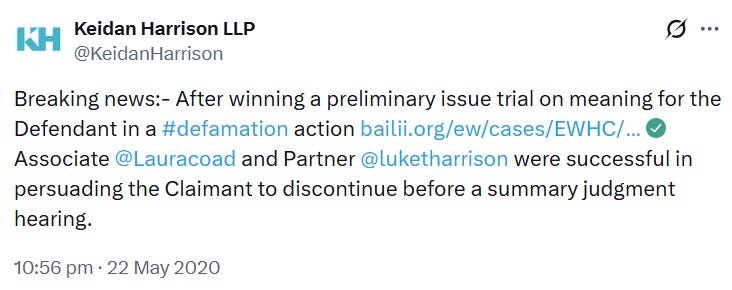
On social media, Kirkegaard has repeatedly lied about my legal defence and made up a false narrative: “One cannot really win when the judge just claims it’s [an] ‘opinion’ or ‘commentary’, when actually ODS is the original source.” Of course, this is nonsense. I was not the “original source” of my honestly held opinions. My opinions were and still are based on Emil Kirkegaard’s blog posts and comments; it was him, who said that he wants to legalise child pornography, admitted to accessing it, and supports abolishing age of consent or reducing it to 13-years old or younger. It was his unpleasant writings I read that I based my opinion he is a paedophilia apologist; my view has not changed. In contrast, Kirkegaard has being ludicrously claiming that I was the “original source”.
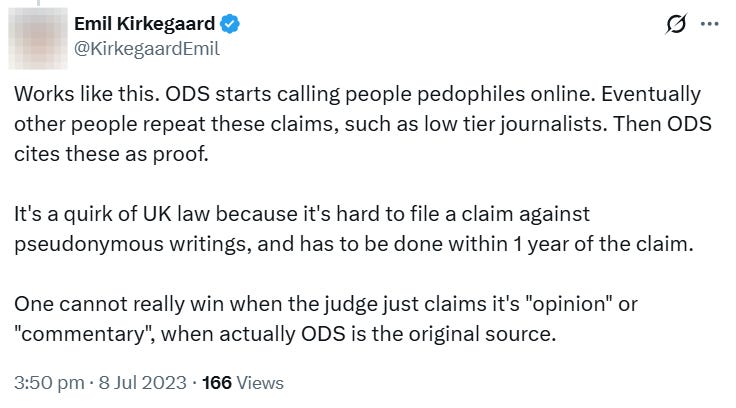
In a blog post in July 2022, Kirkegaard erroneously claimed I quoted his posts on child pornography out of context. Not only is this untrue but the exact opposite of the truth. Kirkegaard from the beginning of his frivolous lawsuit misconstrued my posts. I never took anything he wrote out of context—that is what he did to me. He was criticised in the preliminary judgment for doing exactly this (Kirkegaard v Smith [2019] EWHC 3393 (QB) at [63]). He submitted incorrect meanings of my four posts (the judge in contrast, agreed with my meanings) and quoted them out of context by ignoring the hyperlinks. Kirkegaard tells so many lies and has such a distorted sense of reality, he often inverts the truth; there is not much point in trying to reason with someone with this mindset.
Addendum
While writing this long post, I got in contact with Erik Ahrens now named Andrew Y who was a former friend and associate of Kirkegaard. As noted above, Ahrens fell out with Kirkegaard; he then published a blog post leaking information about Kirkegaard (such as Kirkegaard’s Human Diversity Foundation74) and his business connection to Mathilda Huss (screenshot). Ahrens confirmed Kirkegaard had lived at (or at least was visiting frequently) the Villa Adlon up to January 2024 but relocated to Spain; he lived in Spain for about five months and afterwards traveled to other countries. Ahrens told me he later moved to Berlin. I managed to confirm this, since Kirkegaard in his sworn affidavit (on 10 October 2025), explicitly stated his address was an apartment in Berlin.
I consider Ahrens to be a reliable source of information concerning Kirkegaard (since most of his claims I have independently verified). Ahrens for months, had stayed with Kirkegaard at a house in Spain. Furthermore, he was formerly involved in setting up a company with Kirkegaard’s girlfriend (Liegent LLC) and was a close friend. According to Ahrens, Kirkegaard often discussed his dislike of me with him and openly admitted he was evading my enforcement proceedings. What Kirkegaard told Ahrens in private contradicted what he wrote in court witness statements, which sums up his dishonest character. Most concerning is Ahrens told me Kirkegaard planned in early 2024, to kill me by hiring a hitman on the dark web (as a way to stop paying me the judgment debt).

Ahrens made a video on YouTube repeating the hitman accusation but Kirkegaard has been trying to get the video deleted, and has likely threatened legal action. Regardless, since Ahrens has no recordings, there is no point in reporting Kirkegaard to police (it will be his word against Ahrens). That said, after Ahrens told me Kirkegaard moved to Berlin and I obtained his address from his affidavit—I contacted the nearby Bürgeramt (Local Citizens’ Office). They confirmed Kirkegaard has not registered his address and this is a violation of the German Federal Registration Act (Section 17). Under German federal law, any person who moves to a new residence (including EU citizens) have to register the address within two weeks, if they intend to stay longer than three months.
Kirkegaard has been violating the German Federal Registration Act for many months, if not a year or more. This administration offence is up to €1,000. Furthermore, it may be the case Kirkegaard has broken similar laws in Germany. Kirkegaard does not need a visa, or residence permit to enter Germany because he is an EU citizen (he was born in Denmark) but he appears to be abusing the EU’s ‘right to free movement’. Basically this allows people to freely move between EU member states (without any conditions imposed) for up to three months. After three months, they have to register an address (with local authorities) and provide evidence of employment, study, or self-sufficiency. Kirkegaard has long been exploiting the ‘right to free movement’ by failing to register.
Finally, I have received confirmation that Kirkegaard is breaching rules in the German Commercial Register (Handelsregister). Kirkegaard deregistered from the Kiel address I initiated enforcement against, years ago, but he never removed this same address from the commercial register; at the District Court of Kiel (Amtsgericht Kiel). This explains how I was able to serve him via service by publication on a court noticeboard. There is an obligation for managing directors of companies in Germany to keep their company address up to date on the German Commercial Register. Failure can result in a fine of €5,000 under the German Commercial Code (Book 1, Division 2, s. 14) and/or company dissolution for long-term negligence. To date, Kirkegaard has not updated his address.
The libel lawsuit had lasted six years and seven months. To my knowledge, the longest libel claim in the United Kingdom was the McLibel case (McDonald's Corporation v Steel & Morris).
My harassment claim was filed as a separate claim so was not a counterclaim, despite it was for all intents and purposes the same as a counterclaim; the reason it was filed as a separate claim is I did not file it with a defence in Kirkegaard v Smith, and instead of applying to court to request permission to bring the counterclaim (CPR 20.4), I simply filed the separate claim.
Also known as Kirkegaard (Engman) v Smith.
Smith v Kirkegaard [2024] EWCA Civ 698 (21 June 2024) at paragraphs [50], [51].
He was meant to be questioned (under oath) by a court officer about his income, and assets, but he unreasonably failed to attend; the modest court fee (£65) I paid was added to his debt.
Smith v Kirkegaard [2024] EWCA Civ 698 at [7], [9], [13] (Kirkegaard breached an interim costs order (£13,500) [here] and final costs certificate (£26,686.43) [here]). In the Court of Appeal he breached a default costs certificate (£1,140.54). Combined these total £41,326.97 and accrued over £50,000 (by post-judgment interest) the day the settlement was reached on 19 June 2025.
According to the OpenPsych website (About): “In 2014, Emil O. W. Kirkegaard and Davide Piffer setup three journals in the areas of differential psychology and behavioral genetics”.
My unpublished manuscript is a study of the psychological characteristics that differentiate individuals who report UFOs or claim to have first-hand witnessed UFOs from the general population who do not (an overview of the ‘psychology of UFO reporting’ can be read here).
Van der Merwe, 2018 (“a pseudoscience factory”); Bird, 2019 (“The OpenPsych journals have no formal review process”); Panofsky et al. 2020; Giangrande and Turkheimer, 2022 (“Open Behavioral Genetics, and related journals in the OpenPsych network (also created and edited by Kirkegaard) have been dismissed by experts in the field as pseudo-scientific vehicles for scientific racism”); Non and Cerdeña, 2024 (“Pseudoscience journal group OpenPsych”), etc. In fact it has been noted “OpenPsych is used as an example in ethics courses […] which flouts peer-review.” OpenPsych published an editorial to respond to the criticisms (Carl et al. 2018).
Kirkegaard has since deleted my account (Krom) and my forum posts. I registered a second pseudonymous account on the forum (Tomb Raider) because he disabled access to my first.
The same IP-address, in 2016, I used to make edits on Wikipedia on stage magicians, insect viriforms, and PC game Die by the Sword. Kirkegaard found these edits but to his frustration he could not identify my real name and it took him a year longer to find out my real identity.
I also created the Emil O. W. Kirkegaard article (webpage archive).
Piffer in 2014 on the OpenPsych forum wrote: “I think I possess both PK [psychokinesis] and ESP [extrasensory perception]” and “Extrasensory perception (ESP) is real”. Kirkegaard was apparently embarrassed by Piffer’s irrational posts and erased them after negative publicity.
Kirkegaard on his blog and edits he made on RationalWiki (before he was banned) confused me with someone else’s RationalWiki account (user: Skeptical). This account uses American-English (in contrast, I spell using British-English) for example, “skeptical” tends to be a US-spelling (I spell the word, “sceptical”). This same account further identifies as an American and has US political boxes on their user page. Suffice to say, this account is not mine; aside from the spelling differences, I am not an American and have little to no interest in politics.
According to Kirkegaard, he was offered a job so quit studying his Master’s degree. Having searched company records, I can confirm what Kirkegaard says is true but what he does not disclose is the job was in fact provided by his father. In August 2016, a few months after the scandal, Kirkegaard was made a shareholder in his father’s cleaning products company (Den Grønne Netbutik IVS). Records reveal the company dissolved in 2020 (annual accounts were only filed for the years 2017 and 2018). It was reported under ‘compulsory dissolution’ by the Danish Business Authority for an irregularity; likely failing to file an annual account in 2019.
Kirkegaard noted on his website his income at the time was a university grant. In his own words: “Basically I do it mostly for the money (the Danish state will pay you to study, and education is free).” When he quit his Master’s degree this grant ended. He was unemployed when he was studying at Aarhus University, so clearly could not have been a paid scientist.
For example, in Italy, "Psychologist" (Psicologo) is a legally protected title; it thus requires to pass a state examination, a Master’s degree, and be registered with the Ordine degli Psicologi.
Daniel Rae (pers. comm.). Rae told me Kirkegaard boasted to him to have an IQ in the 98th percentile (requirement for admission to high-IQ societies like Mensa) but refused to verify this when Rae repeatedly asked for proof of his IQ score. Another person told me the same.
Aside from the OkCupid scandal, Kirkegaard was embroiled in another controversy at the University College London. He had attended conferences but they had breached the room booking process of the university and were clandestine. These conferences (so-called LCI) gained bad publicity in tabloids (such as The Guardian, The Telegraph, and The Independent) and an article in London Student which prompted the university to later publish an inquiry.
This post (24 February 2010) is titled: “Om Forbuddet Mod Animeret Børneporno” (“About the Ban on Animated Child Pornography”). Kirkegaard translated the post on 8 March 2010.
These misspelt words appear to be textspeak shortenings.
I reported Kirkegaard to the Midt-og Vestjyllands Politi (Central and West Jutland Police) and Sydøstjyllands Politi (South East Jutland Police) since his last two Danish residences were in Viborg (2017) and Horsens (2019-2021). Note that in 2018, he was living in the US.
Aporia is owned by Emil Kirkegaard (it was previously named Ideas Sleep Furiously) and now edited by Noah Carl and Bo Winegard; curiously, its former editor-in-chief Matthew Archer (Frost) contacted me and requested I publish an article on cryptozoology for Aporia and said he would host a debate between myself and Michael Woodley since we both have published peer-reviewed papers on cryptids. I turned down this offer and I do not want anything to do with Aporia. Adam Rutherford was similarly approached by Archer and he rejected his offer.
I have not commented on The Unz Review since March 2021. The comments Kirkegaard sued me for were published on the “Karlin blog” (Kirkegaard v Smith [2019] EWHC 3393 (QB) at [6]).
A psychiatric definition of a paedophile is an adult with sexual preference for prepubescent and pubescent children (the ICD-10 includes “early pubertal age” [F65.4] and incorporates it in its definition so paedophilia overlaps with so-called hebephilia which is arguably part of the same ‘pedohebephilic’ disorder). The psychiatric definition says nothing about whether paedophiles commit child sexual abuse and some do not act on their urges or fantasies. The colloquial definitions of a paedophile slightly differ by country, but typically mean an adult who is sexually attracted to or commits a sex crime against a child under the age of consent.
I personally doubt this and it is an extremely poor justification to access child pornography. In 2009, a German politician was charged with possession and distribution of child porn but had used Kirkegaard’s dubious argument he was committing these illegal acts for “research”.
In a comment on 12 November 2018, Emil Kirkegaard mentioned his “lawyers”. By this time he had already sent his vexatious letter before claim, and was tying to intimidate me further.
The common law defence of fair comment was abolished by the Defamation Act 2013 and it was replaced with the statutory defence of honest opinion (see: Explanatory Notes #19 [s. 3]).
In other comments on a forum, Kirkegaard criticised age of consent laws (at 16 to 18) in the US as being too high and wanted to lower them; he also favoured abolishing age of consent.
In this 2011 post, Kirkegaard argued unconscious women can neither consent nor withhold consent so cannot explicitly be raped against their will and it is “less immoral” to rape them if they are not awake. This mirrors his suggestion to paedophiles as a “compromise” to drug and rape sleeping children. Neither of these posts are thought experiments or philosophical.
In 2016, Kirkegaard again defended incest in a tweet (screenshot), describing legalising non-reproductive incest as “utilitarians getting things right before society as a whole”. I was told by someone that he also posted many comments supportive of legalising incest on a Danish chatroom, but since these were posted under a pseudonym, I cannot verify if he wrote them.
A statement of case includes the claim form, particulars of claim, defence, counterclaim and reply to defence. Any of these can be struck out under CPR 3.4(2)(b), for an abuse of process.
Under Section 42 of the Senior Courts Act 1981, the Attorney General can prevent a person who is a vexatious litigant from initiating new civil proceedings without permission from a judge effectively preventing or at least making it hard for them to file a new frivolous claim.
I was represented by Debenhams Ottaway (January 2019 to April 2020) and Keidan Harrison (May 2020 to October 2021). Beyond that date, I was a litigant in person representing myself.
The blog post was not indexed by search-engines and was only online for one or two days at most. This was in fact a mistake as it was meant to be a private (or password protected) post.
Morgan v Associated Newspapers Ltd [2018] EWHC 1850 (QB) (28 June 2018) at paragraph [10]; see also: Bokova v Associated Newspapers Ltd [2018] EWHC 2032 (QB) (31 July 2018) at [9], [10].
My barrister (at the preliminary hearing) noted that Kirkegaard had a history of “repeatedly smearing and attacking me” on his blog (Kirkegaard v Smith [2019] EWHC 3393 (QB) at [41b]).
Burnstein v Times Newspapers Ltd [2000] EWCA Civ 338 (20 December 2000) at paragraph [25]; see also: Dhir v Saddler [2017] EWHC 3155 (QB) at [99] (“the Claimant’s behaviour is relevant on the issue of damages”). Kirkegaard provoked me into writing all the posts he sued me for.
The statute of limitations (six years) has passed to file a misuse of private information claim against Kirkegaard uploading the snippet and so I decided to publicly post this information. Regrettably, I did not amend my harassment claim to add misuse of private information (KB-2024-000772). It is though well documented, Kirkegaard has breached my privacy (see above).
On the basis his statement of case is an “abuse of the court’s process” and “the claimant has failed to show that it is more likely than not the claim would succeed at trial” (CPR 3.4(2)(d)).
My solicitor had carelessly relied upon evidence not included in the agreed hearing bundle. There was no excuse for this mistake which led to the adjournment; the Legal Ombudsman ordered the law firm to reimburse my costs for poor service and mishandling my complaint.
At the time, my monthly income was £317, and I had £950 savings (any money I raised went towards paying legal costs), so I applied to vary the order to pay monthly installments; since I could not afford to pay (£6,978). Kirkegaard lost the preliminary judgment one week before the hearing on my application to vary the order and he was ordered to pay me: £13,500. The hearing was vacated, since we could set-off the orders and he owed the net-balance (£6,522).
This was a pointless application since I had not filed any statement of case (counterclaim or defence) for him to strike out under CPR 3.4(2)(c), and the reason I had not paid the £6,978 is I did not have it so applied to pay by installments. Kirkegaard’s application was criticised by Justice Nicklin in an order (25 June 2019), “[T]he Court will wish to scrutinise the Claimant’s Application with care” and rejected his request for a ruling on the papers without a hearing.
Corbyn v Millett [2021] EWCA Civ 567 (20 April 2021) at paragraph [10].
Under common law, there is not an “entirely satisfactory definition of the word defamatory” (Berkoff v Burchill & Anor [1996] EWCA Civ 564), however, defamation is typically defined in case law as as statement (words) that tends “to lower the claimant in the estimation of right-thinking members of society generally” and has a “substantially adverse effect” on the way persons treat the claimant (Thornton v Telegraph Media Group Ltd [2010] EWHC 1414 (QB) at [29], [30], [96]; Corbyn v Millett [2021] EWCA Civ 567 at [9]; Blake & Ors v Fox [2023] EWCA Civ 1000 at [33]). This is a lower-bar threshold to “serious harm” under Section 1 of the statutory Defamation Act 2013; in which the burden falls on the claimant to prove harm to reputation.
My tweet was also deleted as part of the larger deleted thread; Kirkegaard put no effort into providing analytical data about its extent of publication. The significance of having to show analytical data for tweets was highlighted in Chandler v O'Connor [2019] EWHC 3181 (QB) at [21]. It was not possible for my single tweet to have damaged Kirkegaard’s reputation; it was clicked on, or read by very few people (it had zero retweets). The publication was so limited, I had grounds to strike it out under ‘Jameel’ abuse of process since costs of the proceedings (tens of thousands) were disproportionate to the benefit of potential reputation vindication.
With the exception of a single post that partly meant: “Claimant supports the possession of animated child pornography and wishes to see it legalised and is a paedophile” (Kirkegaard v Smith [2019] EWHC 3393 (QB) at [71a]). However, it should be noted that this meaning of the word “paedophile” still did not resemble Kirkegaard’s (“sexual abuser of children”). Instead, it meant (in my opinion) Kirkegaard was sexually attracted to children based on his support for legalising (animated) child pornography (note that he admitted to accessing child porn).
The court can infer “serious harm” based on the ‘Chase levels’ of an accusation. They come from the decision of Lord Justice Brooke in Chase v News Group Newspapers Ltd [2003] EMLR 11 at [45] in which he identified three levels of defamatory imputation: (1) being guilty of the act; (2) reasonable grounds to suspect being guilty of the act and (3) grounds to investigate if guilty of the act. None of these levels apply to the meanings of my four posts (since they did not mean Kirkegaard commits or is suspected of child sex abuse but he is an apologist for it).
CPR 6.23(2)(c) also makes clear: “where there is no solicitor acting for the party—an address within the United Kingdom at which the party resides or carries on business”. Kirkegaard’s notice of change was therefore invalid since he wrote a Danish address as litigant in person.
My application for set-off was not issued because Kirkegaard did not consent to this set-off; I applied for a consent order and was awaiting his signature on the draft order but he failed to sign or respond to my emails about set-off (under CPR 44.12). This left me with no choice but to enforce the total £13,500 costs order against him, rather than the net-balance (£6,522).
As noted by CPR 81.2: “A ‘penal notice’ is a prominent notice added to the front of an order […] warning that if the person against whom the order is made disobeys the court’s order the person may be held in contempt of court”. Punishments include a fine and/or imprisonment.
My attorney got access to the land registry certificate (Tingbogsattest); the house is owned by the parents of Nima Brodersen Talebi so it seems Kirkegaard was lodging there. According to Erik Ahrens (pers. comm.) Nima is a business associate of Kirkegaard’s (TKB Invest ApS).
“A judgment given in a member state shall be recognised in the other [EU] member states without any special procedure being required” (Article 36, Regulation (EU) No. 1215/2012).
In Germany, Deutsche Post rely on names (for mail delivery). If a name is missing from the mailbox or door, the mail is generally not delivered and returned to the sender. Kirkegaard removed his name from his mailbox or door, so packages I mailed were returned to sender.
Dar Al Arkan v Al Refai [2014] EWCA Civ 715 (23 May 2014) at paragraphs [42], [43].
PT Garuda Indonesia Ltd v Australian Competition and Consumer Commission [2011] FCA 685 at [47]; Warby added pertinent comments, in an article (2025) published in Journal of Media Law.
There a exceptions notably in family proceedings by maintenance orders (Administration of Justice Act 1970, s. 11). These were not applicable to Kirkegaard’s failure to pay me the debt.
Dingemans understood there are “other remedies” (Smith v Kirkegaard [2024] EWCA Civ 698 at [44]) but did not mention fines. He did though mention Hadkinson orders; a remedy used in civil and family proceedings to prevent the party in contempt of court being heard, until they complied with orders they breached (Hadkinson v Hadkinson [1952] P 285). The problem is Emil Kirkegaard was evading the contempt proceedings so a Hadkinson order was futile.
CPR 32.14 (“Proceedings for contempt of court may be brought against a person who makes or causes to be made a false statement in a document, prepared in anticipation of or during these proceedings and verified by a statement of truth, without an honest belief in its truth.”
An article in DeWereldMorgen notes: “the non-existent Arthur Jensen Institute”. Kirkegaard appears to have made up this institute to slop on his OpenPsych papers, to sound impressive but the institute does not exist, at least it has no address (nor any list of its research fellows).
Some of Emil Kirkegaard’s cronies have spread an unsubstantiated allegation I was involved in the investigation Undercover: Exposing the Far Right. I had no involvement whatsoever with this undercover investigation neither contributed to Hope Not Hate’s article. I did not know of their investigation until discovering it was broadcast on Channel 4. Kirkegaard has stated he intends to soon close the Human Diversity Foundation (because HnH’s investigation lost him funding from private donors): “organization is out of funds so it is going to close down”.
I later complained to the HM Courts and Tribunals Service and received an apology.
He provided his bank account information on a donations webpage in 2014 (screenshot).
The County Court at Central London is located in the same building complex as the High Court of Justice (Royal Courts of Justice). Pursuant to CPR 71.4, I told Kirkegaard I would pay his travel expenses to attend court as a debtor for questioning but he failed to respond.
At 8% per annum under Section 17 of the Judgments Act 1838. Note this interest is capped after six years (Limitation Act 1980, s. 24(b)). Although costs orders “expire” after six years; they can be renewed with permission of court by a writ of execution (RSC Order 46, Rule 2).
Service by email (CPR 6.15). Kirkegaard himself had provided me his email for service on his notice of change. This is another reason why his claim he blocked my emails made no sense.
Swifthold-Foundation v Fast International [2024] EWHC 1154 (Ch) at [11]; the authoritative text The Conflict of Laws at [14-069] notes there is a “universally admitted principle that a litigant who has voluntarily submitted himself to the jurisdiction [of a court] by appearing before it cannot afterwards dispute its jurisdiction” (Dicey, Morris and Collins, 15th ed., Vol. 1 [2012]).
I requested declaratory relief that clarified my legal right as a creditor to skip-trace which is not stalking. I think most people can distinguish skip-tracing for debt recovery and stalking.